Modern industrial plants depend on communication between thousands of devices and systems.
Sensors send measurements.
Drives report status.
Controllers exchange data.
Operator stations receive alarms and trends.
Communication networks make this information flow possible.
Traditional instrumentation often used dedicated signal wiring between each field device and the control system.
A transmitter might send a standard analog signal directly to an input card.
These systems remain widely used because they are simple and well understood.
Digital communication has added new possibilities.
Digital protocols can allow multiple devices to communicate over shared networks.
Depending on the technology, a device may provide:
This gives the plant more information than a single analog value.
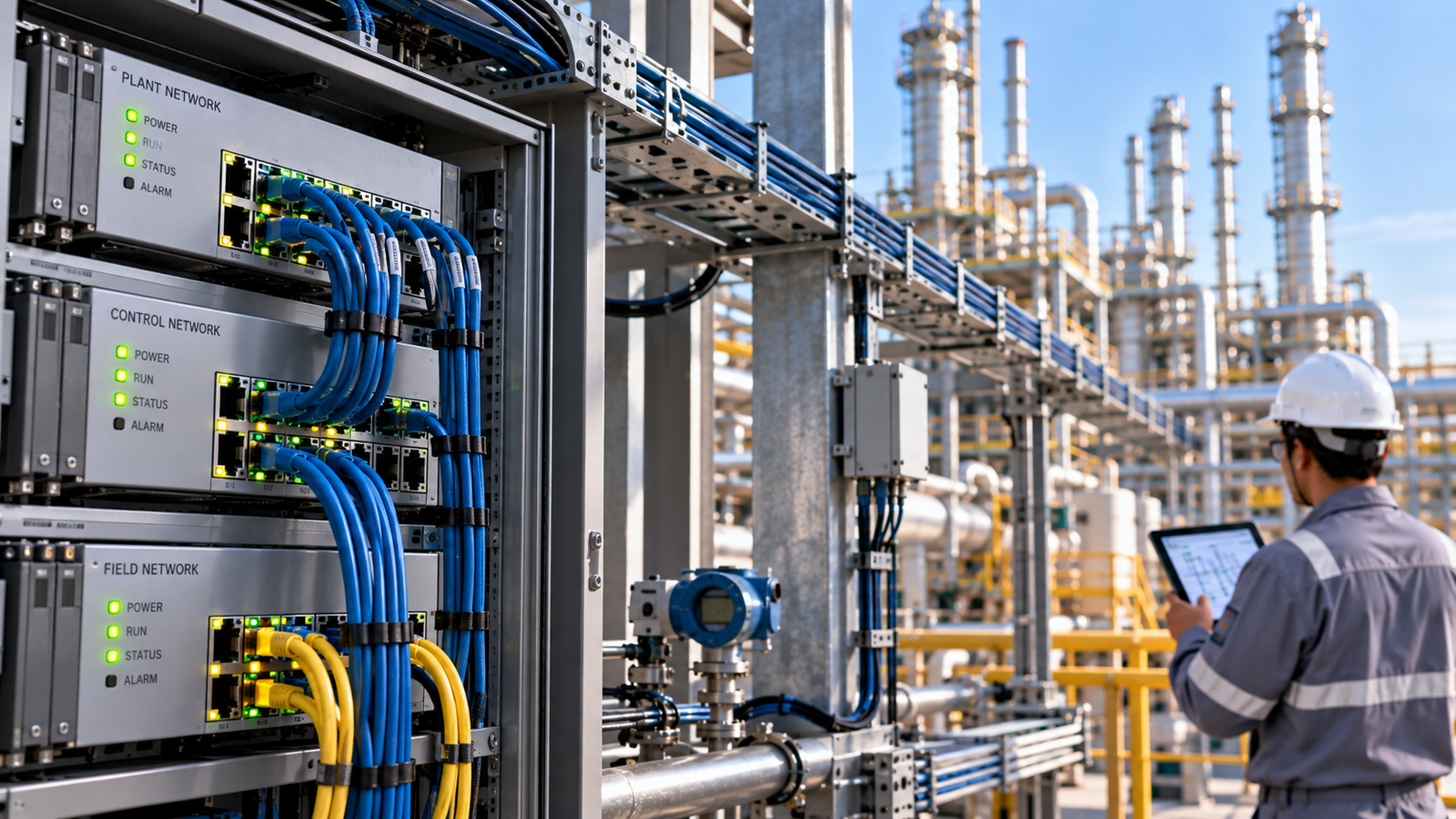
Ethernet-based industrial networks are increasingly used within plant automation systems.
They can connect:
Industrial Ethernet is designed to support plant communication while meeting requirements for reliability and deterministic behaviour where needed.
More connectivity creates benefits, but it also means network performance becomes important.
A communication failure can affect:
Network design therefore needs to consider:
A plant may use several communication technologies at the same time.
Field devices may use one protocol.
Controllers may communicate over another.
Higher-level systems may exchange information over standard Ethernet networks.
The architecture should reflect the function of each layer.
Connecting two systems does not automatically mean they should exchange every available data point.
Engineers need to decide:
Poor integration can create unnecessary complexity.
Industrial networks are no longer just an IT concern.
They are part of the operating plant.
As automation becomes more connected, communication infrastructure increasingly affects the reliability and visibility of plant operations.