Not every equipment condition needs to be checked by someone physically standing next to the machine.
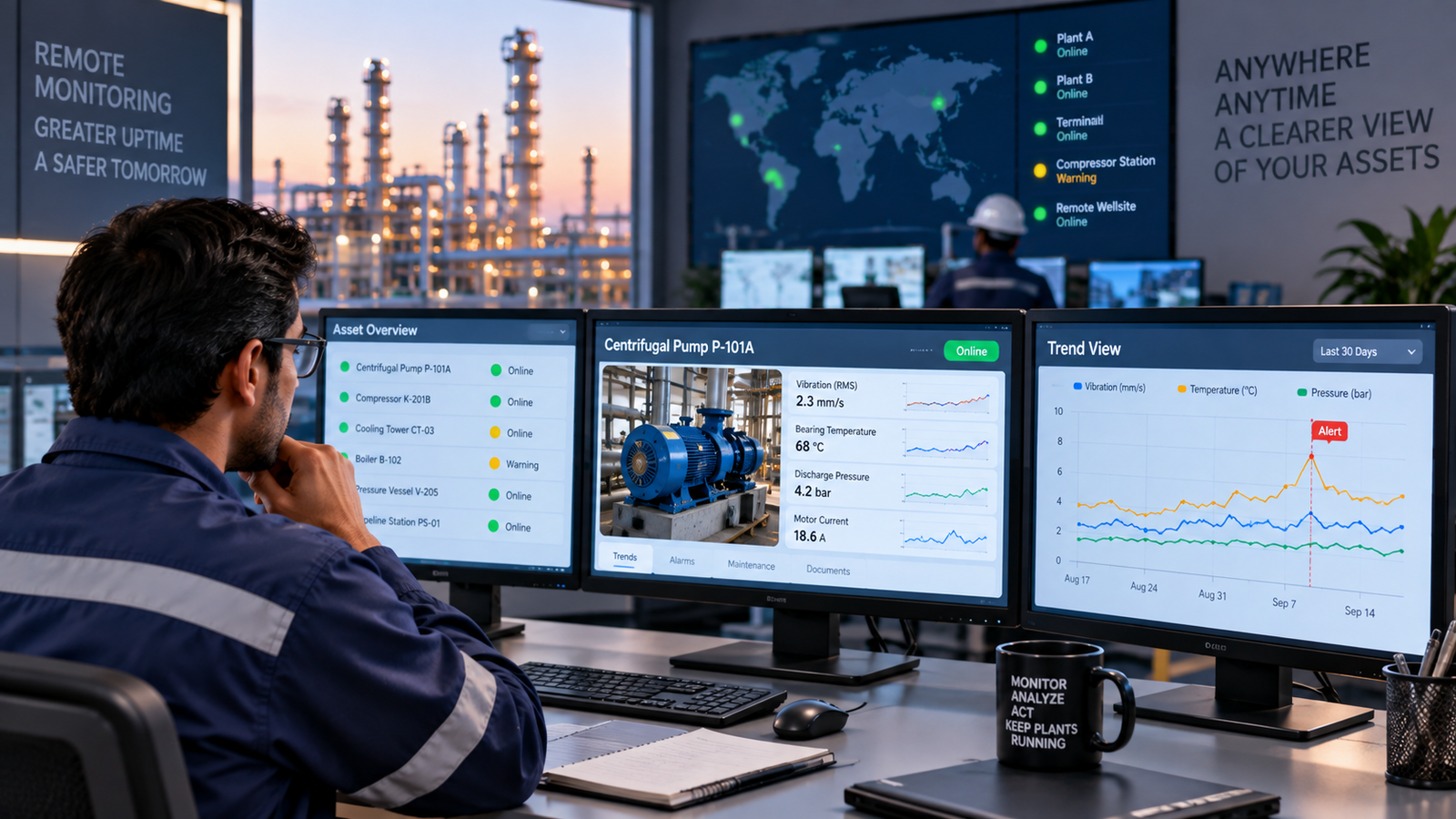
Connected sensors and monitoring systems can allow engineers to observe asset condition from elsewhere in the plant—or from a completely different location.
This has expanded the role of remote monitoring in industrial maintenance.
Sensors may monitor parameters such as:
Instead of relying only on periodic manual inspection, the system can capture how the equipment behaves over time.
A single high temperature may not always indicate a serious problem.
A steady increase over several days may be more meaningful.
Remote monitoring allows teams to observe trends and detect changes that might otherwise be missed between inspection rounds.
Monitoring systems can generate alerts when:
This helps maintenance teams focus attention on equipment showing signs of deterioration.
An alert normally requires interpretation.
Engineers still need to consider:
The system provides information.
People still decide what action is appropriate.
It can be especially valuable for assets that are:
A pipeline pumping station or remote utility asset may benefit significantly from continuous visibility.
A monitoring system is only as useful as the information it receives.
Poor sensor installation, communication failure or incorrect limits can create misleading alerts.
The monitoring equipment itself therefore needs maintenance and validation.
The objective is not to eliminate field inspection.
It is to give plant teams earlier and more continuous insight into asset condition.
Used well, remote monitoring can help plants detect developing problems before they become operational failures.