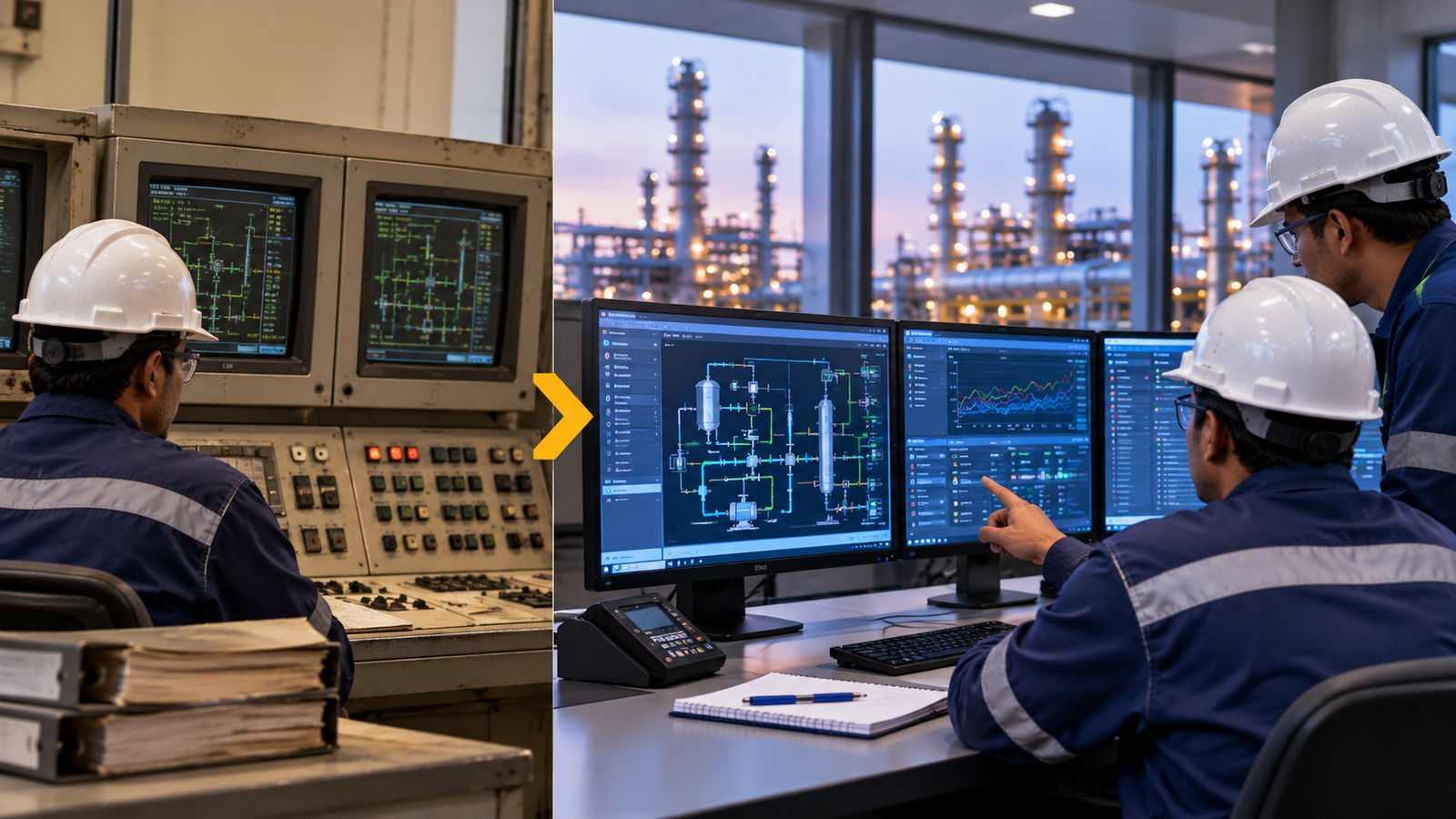
Industrial control systems can remain in service for many years.
Eventually, however, hardware becomes obsolete, software support ends and spare parts become difficult to obtain.
At that point, plants may need to modernise the automation system.
But a control-system upgrade is rarely a simple hardware replacement.
An old control system may contain years of:
Replacing the hardware without understanding this information can create significant operational risk.
Upgrade projects may begin because of:
The urgency depends on how vulnerable the existing system has become.
Plants may choose to:
The strategy needs to balance technical risk with available shutdown windows.
Continuous process plants cannot always stop for long periods.
Automation upgrades therefore need detailed planning around:
The migration plan can be as important as the new technology itself.
The control system may communicate with:
All of these interfaces need to continue working after migration.
Even if the process remains the same, new graphics and system behaviour can change the operator experience.
Training should address:
Operator familiarity is part of safe migration.
Modern automation systems are more connected than many legacy platforms.
That creates opportunities for better integration, but also introduces cybersecurity considerations.
Network architecture, access control and system hardening therefore need to be considered during modernisation.
An automation upgrade affects far more than computers and controllers.
It can affect operators, maintenance, networks, instrumentation, documentation and startup.
That is why control-system modernisation should be treated as a plant change programme, not simply an equipment replacement project.