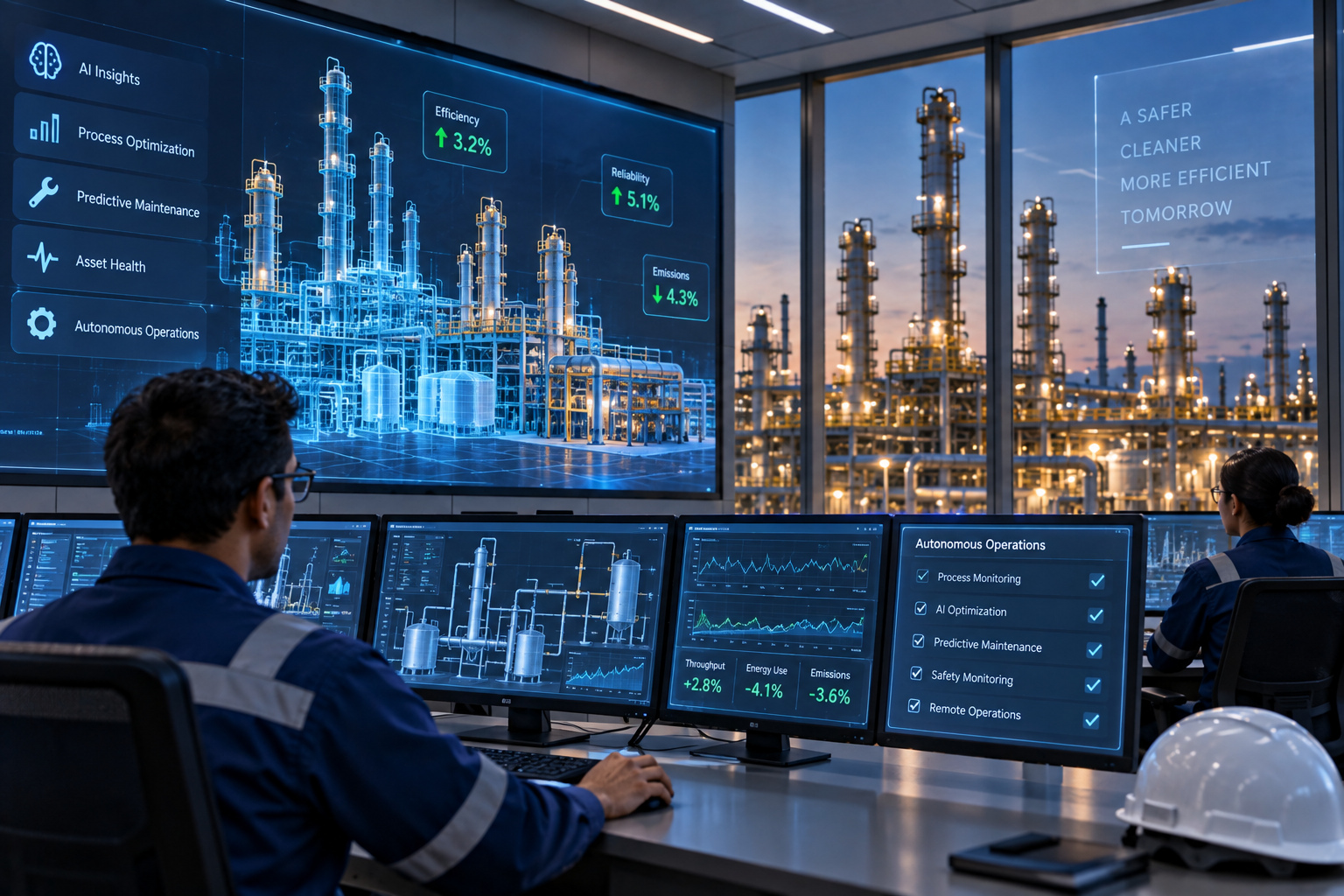
Industrial automation has steadily reduced the amount of manual intervention required to operate plants.
AI, advanced control, robotics and remote monitoring are now raising a bigger question:
How autonomous can an industrial plant become?
Modern plants may automatically manage:
Operators increasingly supervise systems that perform many actions automatically.
More sophisticated systems can adjust multiple process variables together.
They may optimise:
This reduces the need for constant manual adjustment.
AI can help identify patterns, detect anomalies and recommend actions.
In some applications, it may eventually support closed-loop decision making.
But plant operation involves more than repeating known decisions.
Unexpected situations remain difficult.
Steady-state operation may be highly automated.
The challenge appears when something unusual happens.
Examples include:
These situations often require experience and judgement.
Greater autonomy may change the operator’s role.
Instead of continuously adjusting the process, operators may increasingly:
Human involvement may become less frequent but more important when it is required.
Plant teams need to understand why an autonomous system is taking a particular action.
If the reasoning cannot be understood or challenged, operators may be reluctant to trust it.
Industrial autonomy therefore requires not only technical capability but also operational confidence.
A plant does not have to become completely autonomous to gain value.
Even partial autonomy can reduce routine workload and improve consistency.
The practical objective is likely to be:
automate what can be automated reliably, while keeping human judgement where uncertainty, consequence and complexity remain high.