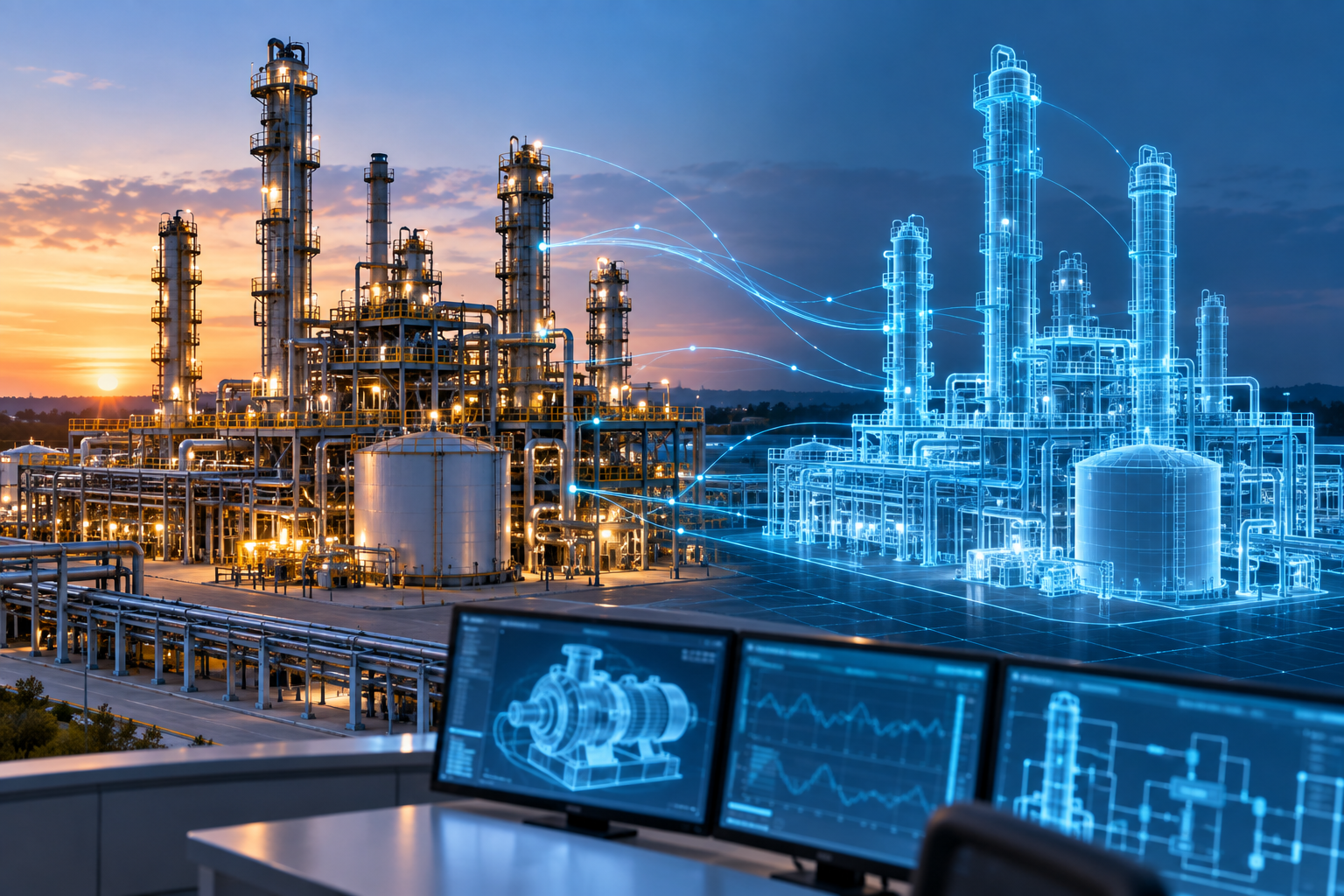
Digital twins are increasingly discussed across industry.
The term can refer to different types of digital representations of physical assets or processes.
At their most useful, digital twins help engineers understand how an asset or process is behaving and how it may respond under different conditions.
A twin may represent:
The model may combine design information, operating data and engineering calculations.
Live plant data can be compared with the expected behaviour of the model.
This may help identify:
The digital representation provides a reference for interpreting real operation.
Engineers can use models to explore questions such as:
This allows some scenarios to be evaluated without experimenting directly on the physical plant.
Every model simplifies reality.
It may depend on assumptions about:
If these assumptions are wrong or outdated, the model can produce misleading conclusions.
A digital twin should be checked against real operating data.
As equipment ages and plant conditions change, the model may need recalibration.
Otherwise the gap between the digital model and physical plant may gradually increase.
A detailed digital twin requires effort to build and maintain.
For some equipment, simpler monitoring or modelling may provide sufficient value.
The level of sophistication should match the business and engineering need.
A digital twin does not replace the engineer.
It provides another tool for understanding the plant.
Used carefully, it can support monitoring, optimisation, troubleshooting and scenario analysis.
But the strongest decisions still combine model insight with actual plant data and engineering judgement.