Plant piping and pipelines perform the same basic function: transporting fluids.
But that does not mean they are engineered in the same way.
The environment inside an industrial plant creates one set of challenges, while a pipeline stretching over long distances introduces another.
Understanding this distinction is important when discussing both under one Piping & Pipelines section.
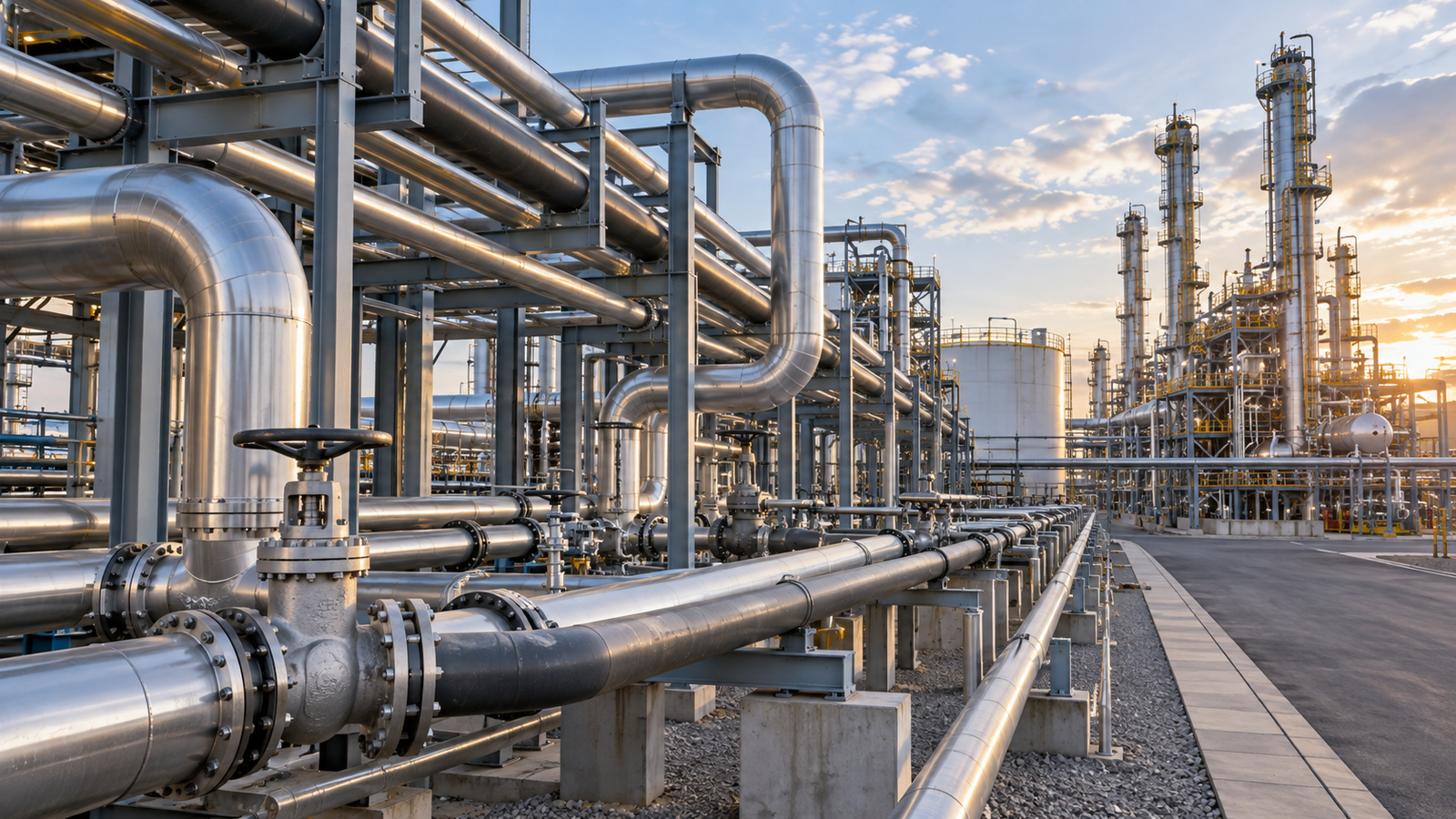
Inside a refinery, chemical plant, power station or manufacturing facility, piping exists within a concentrated environment.
Many different lines may share the same area.
They connect pumps, vessels, heat exchangers, compressors and other equipment.
Routing needs to accommodate structures, access, instrumentation and other piping.
The engineering challenge is often managing many interactions within limited space.
Pipelines may extend across kilometres of changing terrain.
Rather than navigating a congested process unit, they must deal with route selection, ground conditions, crossings, external loads and environmental exposure.
Construction may involve long stretches of field welding, trenching, lowering-in and reinstatement.
The engineering challenge is therefore different in scale and geography.
Plant piping frequently connects directly to process equipment.
This creates considerations such as thermal expansion, nozzle loads, equipment accessibility and changes in operating conditions.
Pipelines interact less frequently with process equipment along their route, but they encounter other interfaces such as roads, rivers, populated areas, terrain changes and third-party activity.
The type of engineering coordination therefore changes.
Plant piping typically involves large numbers of fabricated spools, fittings, valves and connections assembled inside relatively confined areas.
Pipeline construction tends to be more repetitive but extends across much greater distances.
Logistics, route access, field welding, testing and environmental restoration become major considerations.
Neither is inherently simpler.
They simply present different engineering problems.
Both plant piping and pipelines require integrity management.
But the threats may not be identical.
Plant piping can be affected by process-specific corrosion, local temperature conditions, vibration and complex equipment interfaces.
Pipelines may face external corrosion, ground movement, third-party interference and other threats associated with long-distance infrastructure.
Inspection and monitoring strategies therefore need to reflect the type of asset.
Despite the engineering differences, plant piping and pipelines share the same fundamental objective.
They must contain and transport fluids safely and reliably for the intended life of the system.
That shared purpose justifies covering them together.
But good technical coverage should also recognise that piping inside a process plant and pipelines across long distances are not simply different sizes of the same thing.
They are distinct engineering environments with their own priorities, constraints and risks.