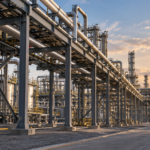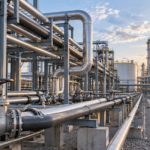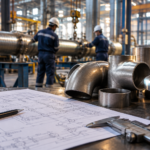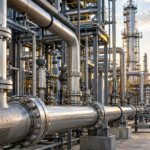
Industrial piping systems may appear rigid, but during operation they are constantly responding to changes in temperature, pressure and mechanical load.
One of the most important of these effects is thermal expansion and contraction.
As piping heats up, it expands. As it cools, it contracts. In high-temperature services or long piping runs, this movement can become significant enough to influence the design of the entire system.
The engineering challenge is not to eliminate movement. It is to control it.
The amount a pipe expands depends on the material, the length of the piping and the change in temperature.
Across a short pipe spool, the movement may be small. Across a long run operating at elevated temperature, the accumulated movement can become substantial.
If that movement is excessively restrained, stresses can develop in the piping and forces can be transferred to connected equipment, supports and structures.
This is why engineers do not consider a piping system only in its cold, installed condition. They also need to understand how it will behave when operating.
One of the simplest ways of accommodating thermal movement is through piping geometry.
Changes in direction, bends and appropriate routing can allow a piping system to flex naturally as it expands and contracts.
Where necessary, engineered features such as expansion loops or other flexibility arrangements may be introduced.
The objective is not maximum flexibility. A piping system that is too loosely restrained can also create problems.
Good design balances flexibility with control.
Pipe supports do more than carry weight.
Guides, anchors and restraints influence how and where piping is allowed to move.
An anchor may establish a fixed point. A guide may permit movement in one direction while restricting it in another. Other supports help carry weight while allowing thermal movement.
The support arrangement therefore becomes part of the flexibility design rather than a separate consideration.
Piping is connected to pumps, compressors, vessels, heat exchangers and other equipment.
If thermal movement produces excessive loads at equipment nozzles, the problem is no longer confined to the piping system.
Engineers therefore need to consider how piping movement affects the equipment it connects to.
This is particularly important in systems where equipment manufacturers specify allowable nozzle loads.
A piping system may experience several temperature conditions during its life.
Normal operation is only one case.
Start-up, shutdown, standby conditions, cleaning operations and abnormal situations may create different temperature profiles.
Different sections of the same system may also heat up or cool down at different rates.
For this reason, flexibility assessments need to consider realistic operating scenarios rather than only one steady-state condition.
Successful piping design recognises that movement is unavoidable.
The goal is to predict where movement will occur, provide sufficient flexibility to accommodate it and control that movement so that stresses and loads remain within acceptable limits.
Much of this engineering is invisible once a plant begins operating.
But when flexibility has been considered properly, the piping system can respond to temperature changes without creating unnecessary stress on itself or the equipment around it.