Industrial plants generate large amounts of operating data every day.
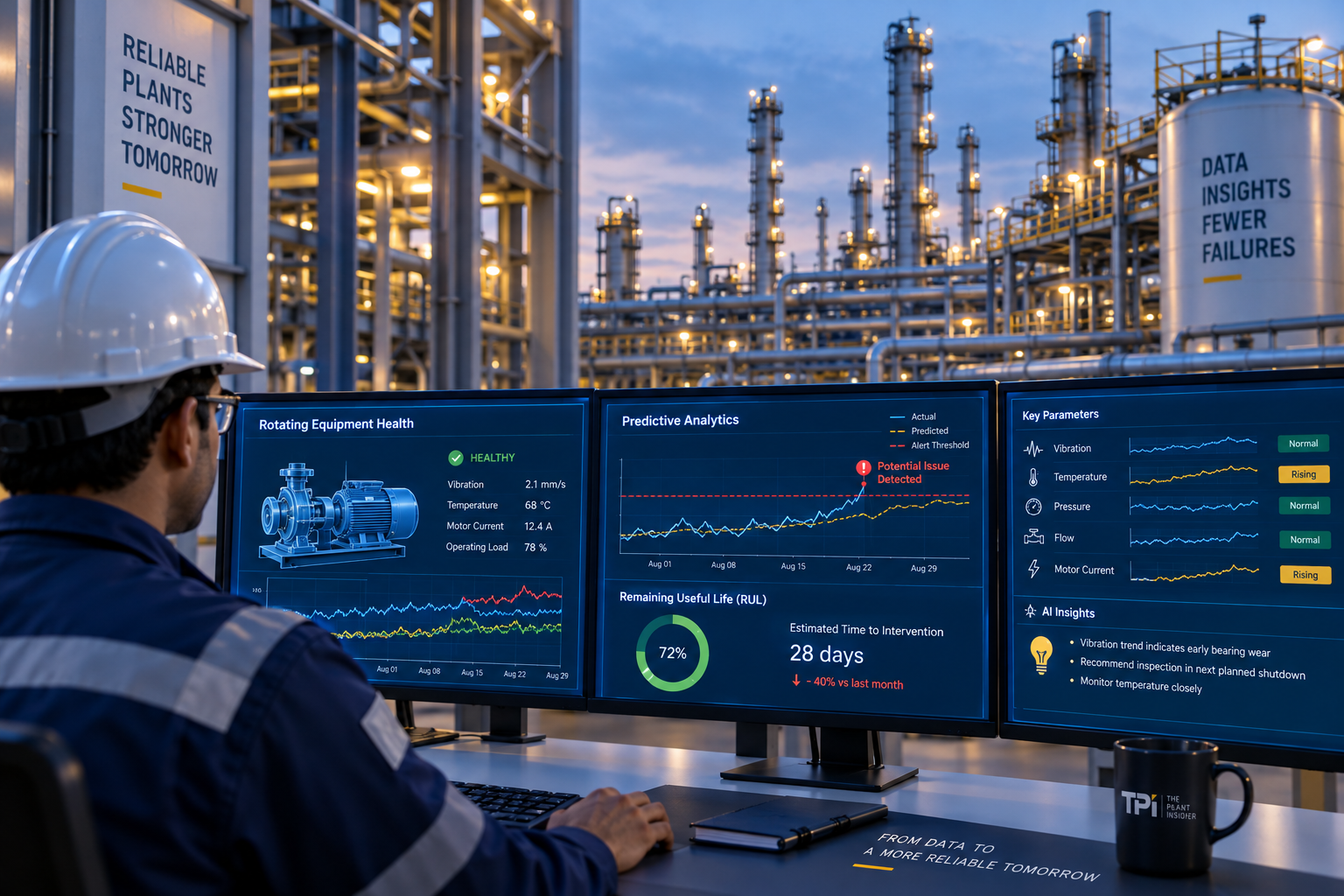
Vibration, temperature, pressure, current, flow and maintenance history can all provide clues about the health of equipment.
Predictive analytics tries to use those clues to identify developing problems before they become failures.
Predictive analytics usually begins with measurable equipment condition.
Common inputs may include:
The value comes from observing how these parameters behave over time.
One abnormal reading does not always indicate a serious problem.
A gradual increase in vibration over several weeks may be more meaningful.
Analytics can help identify patterns that are difficult to see from individual readings.
To recognise abnormal behaviour, the system needs to understand what normal operation looks like.
That may depend on:
A pump running at high load may naturally behave differently from the same pump at low load.
Changes in multiple parameters may point toward issues such as:
The analytics does not necessarily diagnose the fault by itself.
It can indicate that equipment behaviour is changing and deserves investigation.
Predictive models cannot compensate for poor input data.
Problems such as:
can produce misleading results.
Good predictive analytics therefore depends heavily on reliable instrumentation and disciplined data management.
The objective is not to replace maintenance engineers.
It is to give them earlier warning and better evidence.
If a developing problem is identified before failure, the plant may have time to:
Predictive analytics is valuable because it can move maintenance decisions away from emergency response.
The earlier a plant understands that equipment condition is deteriorating, the more options it has to manage the problem.