Earthing and bonding are fundamental parts of industrial electrical systems.
They provide controlled paths for fault currents and help reduce dangerous voltage differences between conductive parts.
Because much of the earthing system is hidden underground or behind equipment, its importance can easily be underestimated.
Electrical equipment can develop faults that make metal enclosures or structures electrically live.
A properly designed earthing system provides a low-impedance path for fault current.
This allows protective devices to detect the fault and disconnect the affected circuit.
Industrial plants contain extensive metallic structures.
These can include:
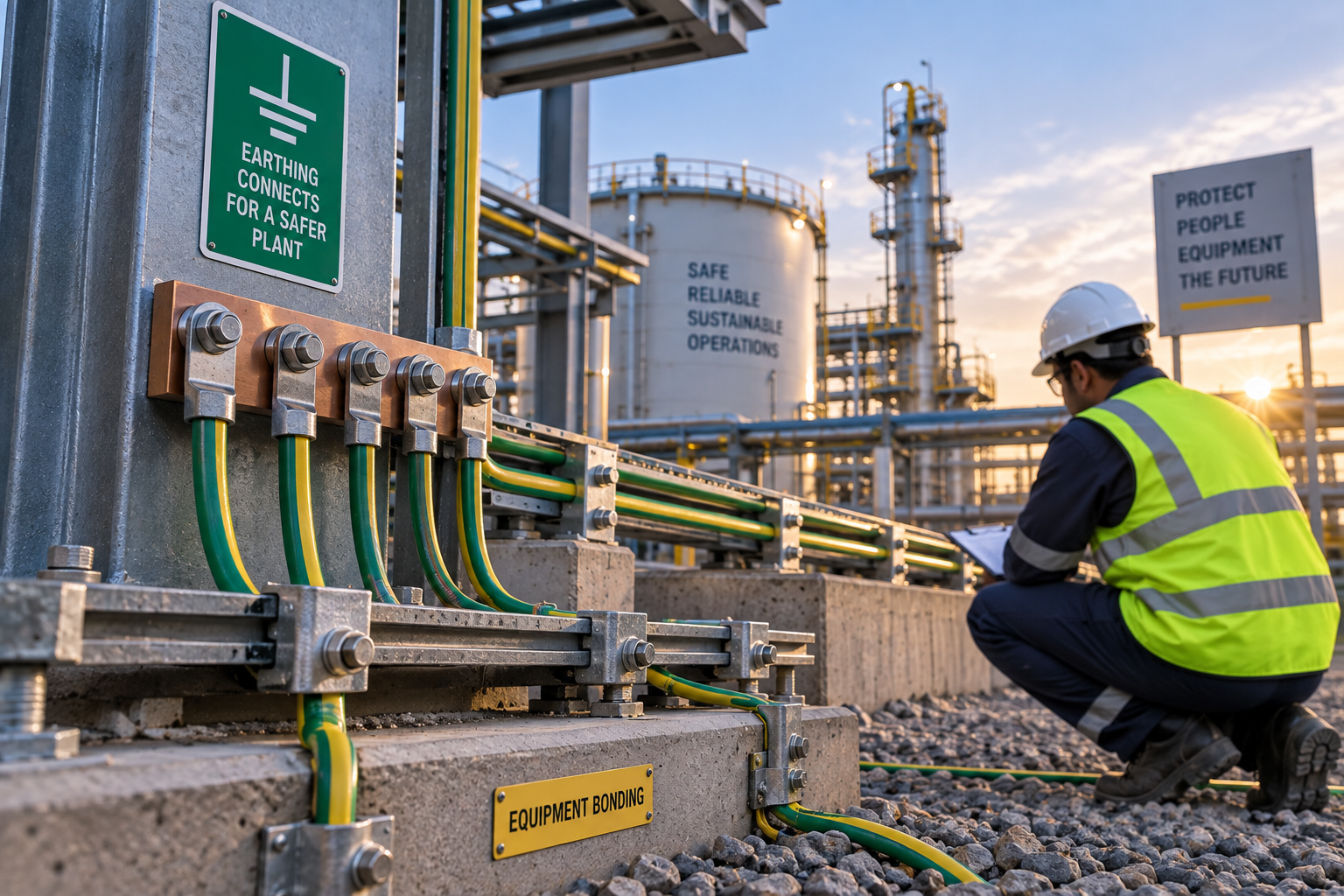
Bonding connects conductive parts together so that dangerous voltage differences are less likely to develop between them.
Large plants often use an interconnected earthing grid.
Equipment and structures are connected to this grid through dedicated conductors.
The grid then interacts with the surrounding soil to dissipate electrical current.
Its design depends on soil conditions, fault levels and plant layout.
During an electrical fault, voltage can develop across the ground surface.
This can create potential differences between a person’s feet or between equipment and the ground.
Earthing design therefore considers step and touch voltages to reduce risk to personnel.
Tall structures, tanks and buildings may also require lightning protection.
Although lightning protection is a distinct engineering subject, it often interacts with the plant earthing network.
A coordinated approach helps manage electrical energy safely.
Earthing does not produce power and operators rarely interact with it directly.
But it supports the safe operation of the entire electrical installation.
Its importance becomes most visible when something goes wrong.