Electrical systems are designed to operate continuously, but faults can still occur.
Short circuits, insulation failures and equipment problems can create abnormal electrical conditions.
Protection systems are designed to detect these conditions and isolate the affected part of the network before the problem becomes more serious.
Electrical faults can produce high current and significant heat.
If they continue for too long, they can damage cables, transformers, motors and switchgear.
Protection therefore has to act quickly enough to limit damage.
But it also has to act selectively.
Ideally, only the faulty section should be disconnected.
If a small downstream fault causes the entire plant electrical system to trip, the protection arrangement has not isolated the problem effectively.
Protection coordination is therefore about deciding which protective device should operate first under different fault conditions.
Protective relays monitor electrical quantities such as:
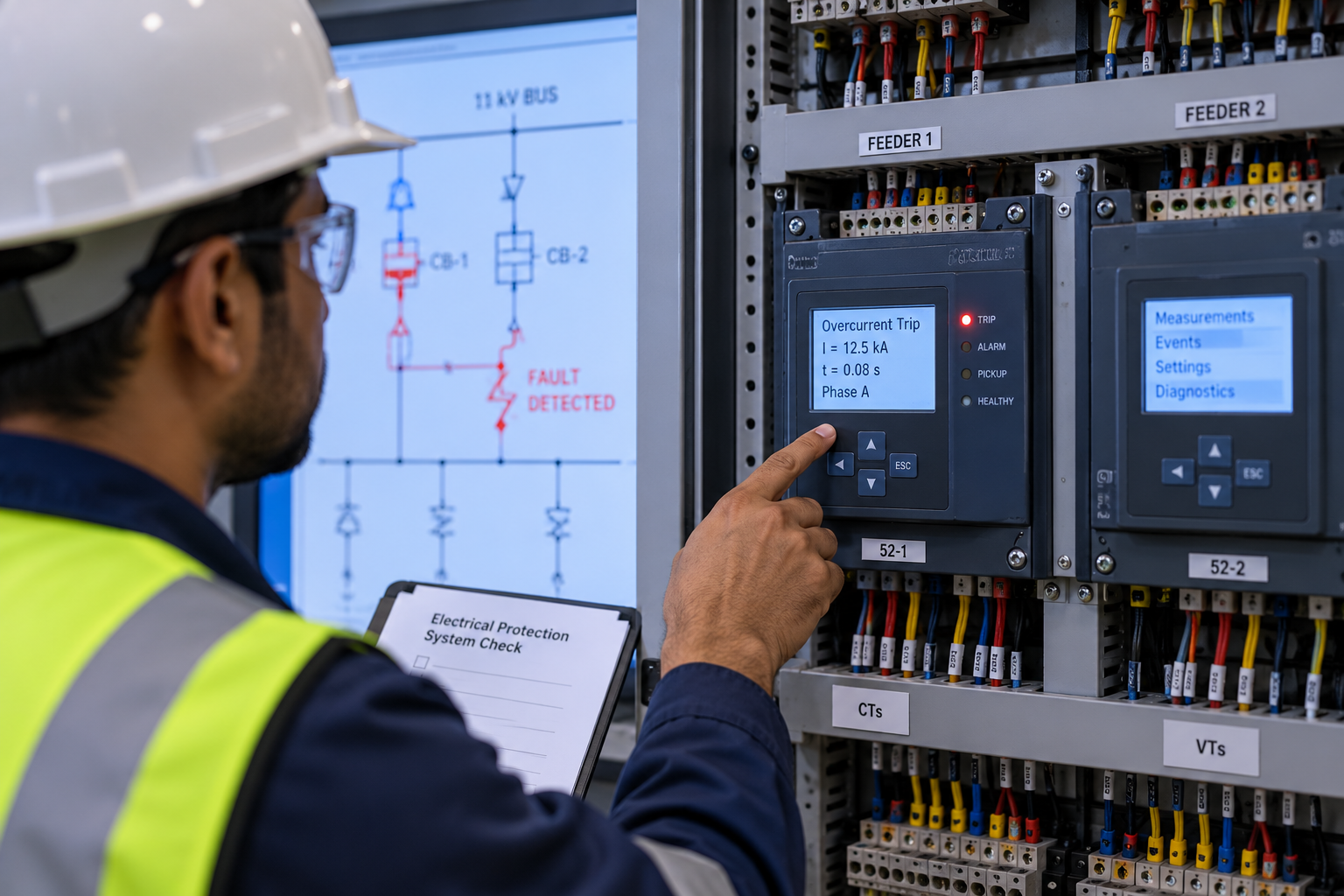
When predefined limits or patterns are detected, the relay can initiate the opening of a circuit breaker.
Different parts of the electrical network may require different protection philosophies.
The relay identifies the problem.
The circuit breaker physically interrupts the electrical current.
The breaker must therefore be capable of safely interrupting the fault current expected at its location.
Protection devices need appropriate settings.
If settings are too sensitive, unnecessary trips may occur.
If they are not sensitive enough, faults may remain connected for too long.
This makes protection studies and coordination an important part of electrical engineering.
Electrical protection is sometimes viewed mainly as a safety requirement.
It also plays an important role in plant continuity.
By isolating faults quickly and selectively, the protection system can limit equipment damage and reduce the extent of electrical outages.