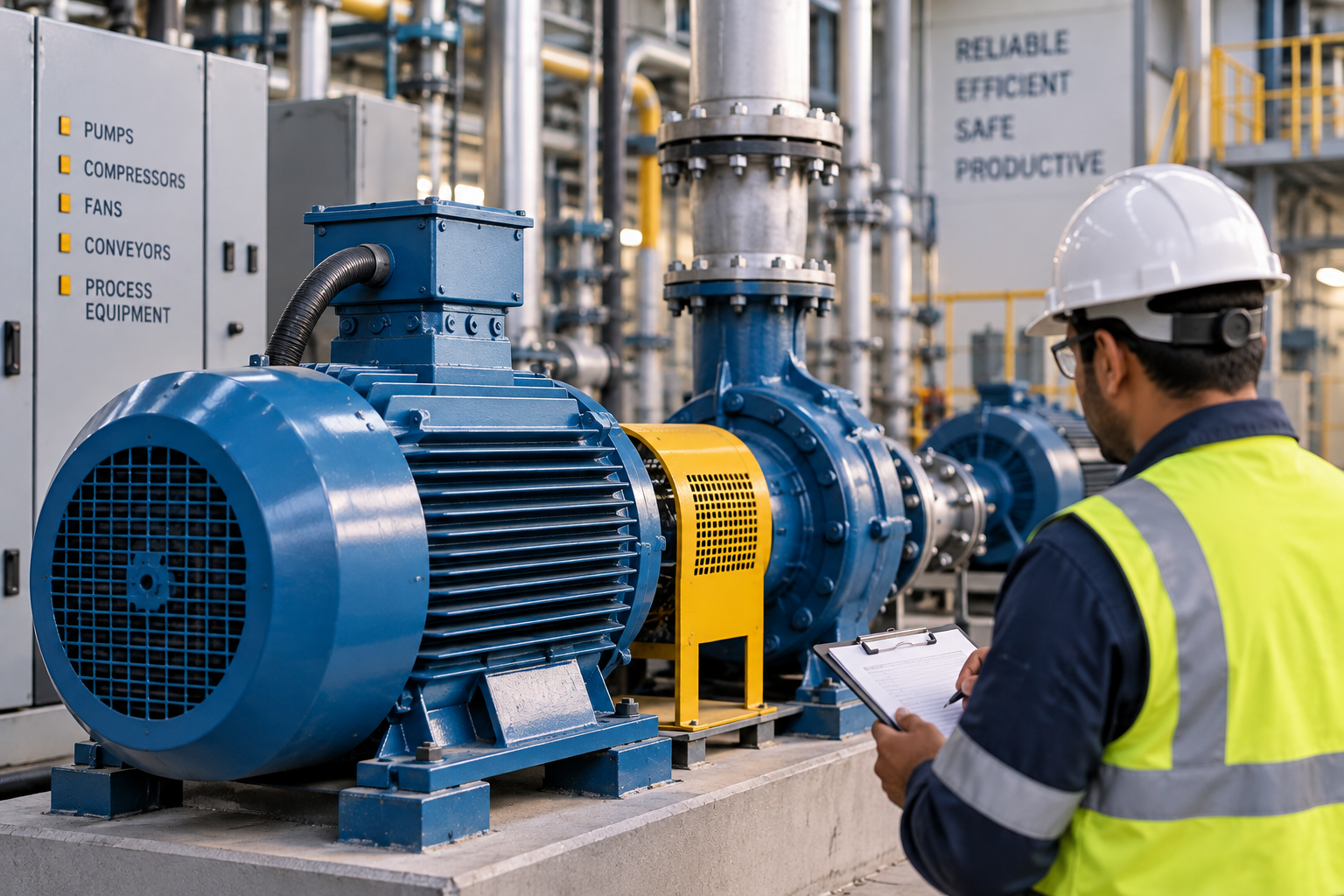
Electric motors drive much of the moving equipment inside industrial plants.
Pumps, fans, compressors, conveyors, blowers and many other machines depend on motors for mechanical power.
Because motors are so common, they can appear straightforward.
In practice, selecting the right motor requires an understanding of both the electrical supply and the mechanical duty.
The motor has to match the equipment it is driving.
A pump, compressor and conveyor may require very different torque and speed characteristics.
Engineers therefore need to understand:
The motor should suit the application rather than simply meet the rated power requirement.
Electric motors can draw significantly higher current during starting than during normal operation.
This can influence switchgear, cables, transformers and the wider electrical network.
Large motors may therefore require specific starting methods to control the effect on the plant power system.
Industrial plants can expose motors to heat, dust, moisture, corrosive atmospheres and hazardous areas.
The motor enclosure and protection level need to match those conditions.
Cooling also becomes important, particularly for motors operating continuously or in high-temperature environments.
Some applications benefit from variable-speed operation.
Variable-frequency drives can allow motor speed to change according to process demand.
This can improve operational flexibility and, in certain applications, reduce energy consumption.
The motor and drive therefore need to be considered together.
A motor may operate for thousands of hours each year.
Even relatively small efficiency differences can therefore influence long-term energy consumption.
For continuously operating equipment, lifecycle energy cost can become more significant than initial purchase price.
The motor does not operate independently.
Its selection affects the electrical network, the driven equipment and the plant operating philosophy.
Good motor selection therefore requires coordination between electrical and mechanical requirements.