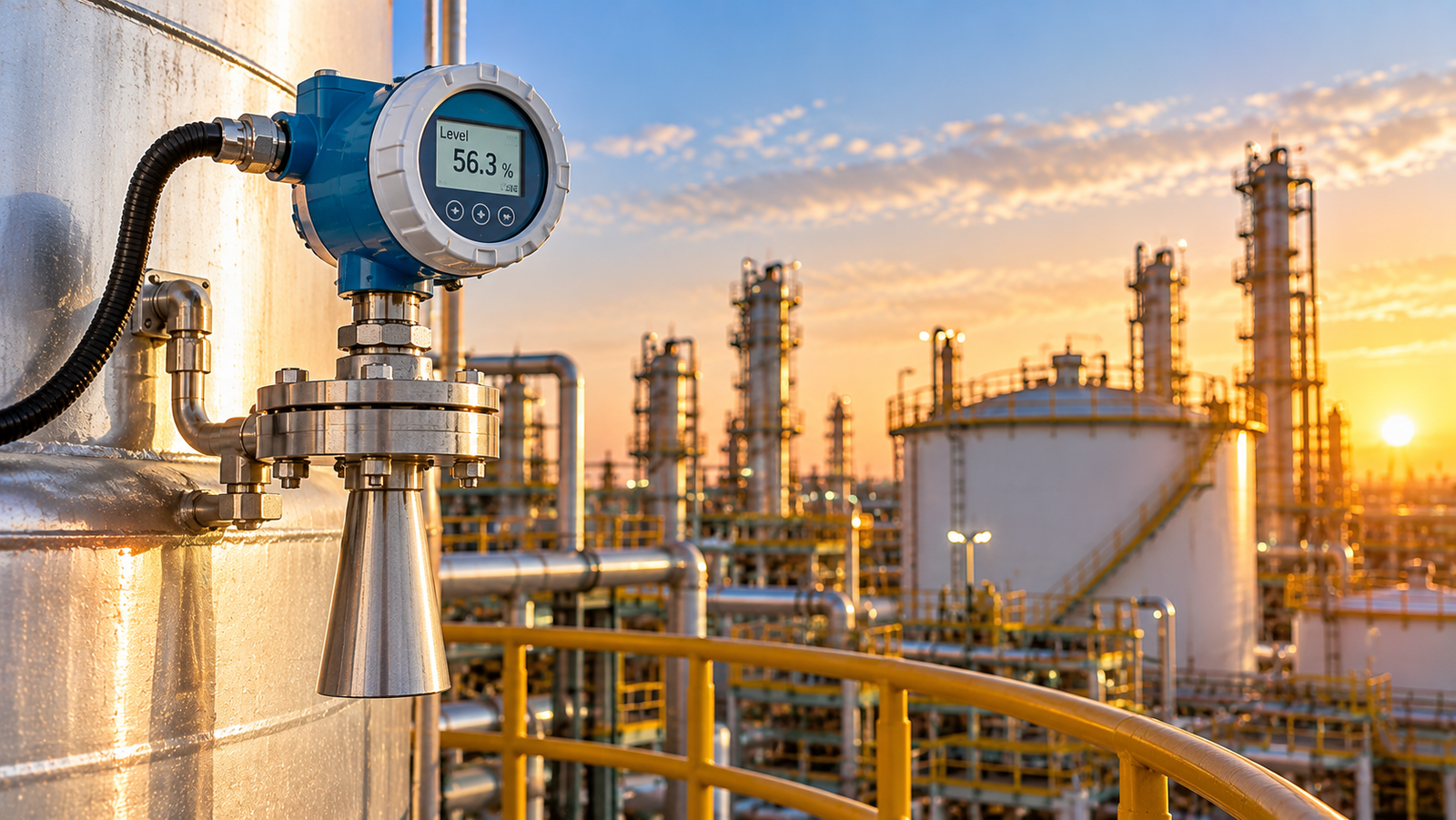
Measuring the amount of material inside a vessel can sound straightforward.
In practice, level measurement can become complex.
Foam, vapour, pressure, temperature, turbulence, vessel geometry and changing fluid properties can all influence the measurement.
The first step is therefore not choosing an instrument.
It is understanding what is happening inside the vessel.
Not every level application serves the same purpose.
The measurement may be used for:
The required reliability and measurement performance depend partly on the function.
A routine process indication and an independent protective measurement may need different engineering approaches.
The environment inside a vessel can be demanding.
Pressure and temperature can vary significantly.
Agitation can create turbulence.
Foam can form above a liquid surface.
Vapour conditions may change.
Some vessels contain solids or multiple liquid phases.
These conditions influence which measurement principles are suitable.
Level can be measured in several ways.
Some technologies detect the surface directly.
Others infer level from another physical property, such as hydrostatic pressure.
Each approach depends on assumptions.
For example, a pressure-based measurement can be affected by changes in liquid density.
Understanding these assumptions is important when assessing whether the measurement will remain reliable under changing process conditions.
Some vessels contain two liquids with different densities.
In these cases, operators may need to know not only total level but also the location of the interface between the liquids.
This creates a different measurement challenge from simply detecting one liquid surface.
The selected technology needs to suit both the vessel and the physical properties of the materials present.
Instrument location can influence performance.
Nozzles, internal structures, agitators, inlet streams and other vessel features can interfere with measurements depending on the technology.
The installation should therefore be considered alongside the vessel design and operating behaviour.
A technically capable device can still perform poorly if installed in an unsuitable location.
High-high or low-low level measurements may be used to protect equipment or prevent undesirable process conditions.
Where level measurement forms part of a protective function, independence, reliability and testing requirements can become especially important.
These applications should not be treated simply as additional indications on the operator screen.
Good level measurement begins with understanding:
what is in the vessel, how it behaves, what operating conditions exist and what decision will be made from the measurement.
Once these questions are clear, instrument selection becomes much more meaningful.