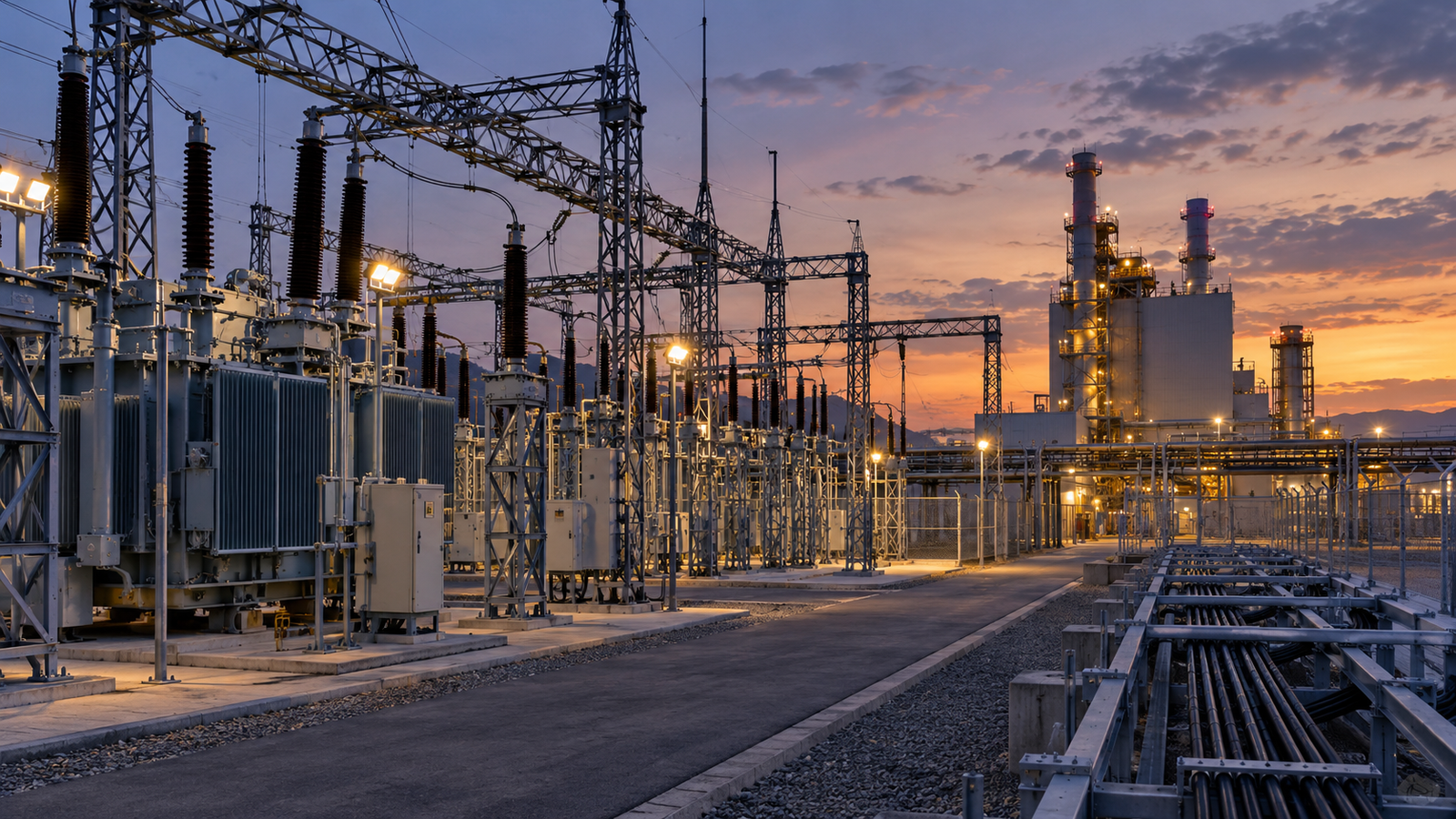
An industrial plant may receive power at high voltage, but that power has to pass through several stages before it reaches a motor, heater, panel or utility system.
That journey usually involves substations, transformers, switchgear, distribution boards and cabling.
The objective is not simply to deliver electricity. The system has to distribute power safely, reliably and at the correct voltage for different plant loads.
Large plants may receive power from the grid at high voltage and then step it down through transformers.
Different parts of the plant may operate at different voltage levels depending on the equipment being supplied.
Large motors may require medium-voltage supply, while smaller motors, lighting and auxiliary systems may operate at lower voltages.
This creates a layered distribution network.
Transformers allow electrical power to move from one voltage level to another.
Their selection depends on factors such as:
A transformer is therefore a critical link between incoming power and plant distribution.
Switchgear allows electrical circuits to be energised, isolated and protected.
Circuit breakers and other protective devices help disconnect sections of the system when faults occur.
This helps prevent a local electrical problem from affecting a larger portion of the plant.
Not all loads are equally critical.
Some equipment can stop without creating a major plant impact.
Others may support safety systems, control systems, critical rotating equipment or essential utilities.
Electrical distribution therefore often reflects the operational importance of different loads.
A reliable electrical system depends on more than individual equipment.
Engineers need to consider how transformers, switchgear, protection systems, cables and plant loads work together.
A weakness in one part of the network can affect equipment far beyond that point.
Industrial electrical distribution is ultimately about moving power from the source to the plant equipment that needs it.
But doing that reliably requires coordinated design across multiple voltage levels and electrical systems.