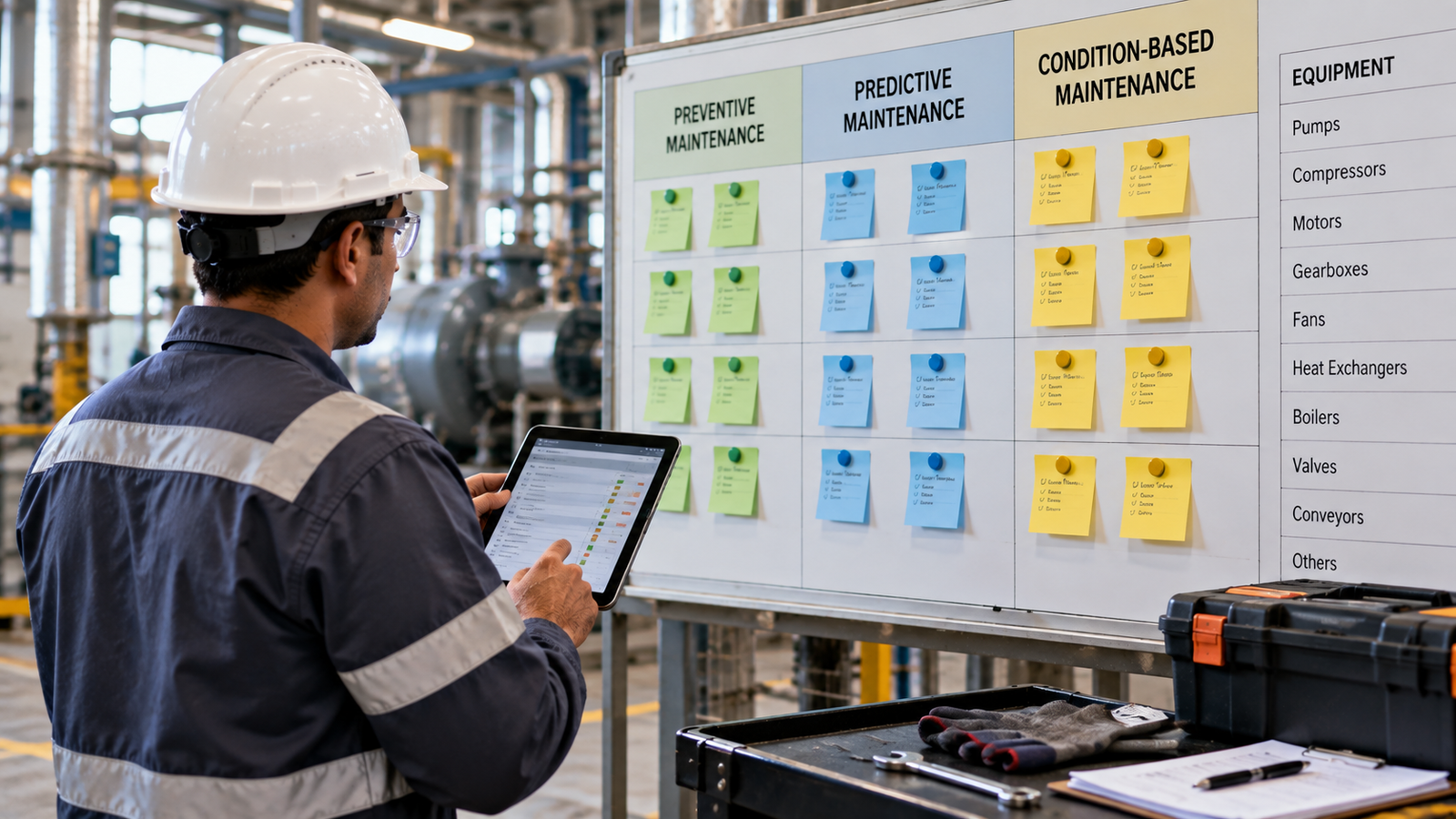
Industrial plants use different maintenance strategies depending on the equipment, its criticality and the consequences of failure.
Terms such as preventive, predictive and condition-based maintenance are often used interchangeably, but they are not exactly the same.
The key difference is what triggers the maintenance activity.
Preventive maintenance is carried out at planned intervals.
The trigger may be:
Typical tasks can include lubrication, inspection, replacement of wear parts and routine servicing.
The advantage is predictability.
Work can be scheduled before failure occurs.
But preventive maintenance can also lead to unnecessary intervention if equipment is serviced simply because the calendar says so.
Predictive maintenance tries to estimate when equipment condition is deteriorating enough to require action.
It may use:
The objective is to identify developing problems before functional failure occurs.
This allows maintenance teams to intervene closer to the point where the work is actually needed.
Condition-based maintenance is triggered when monitored equipment condition reaches a defined threshold or shows abnormal behaviour.
For example, a pump may continue operating normally until vibration exceeds an acceptable level.
At that point, an inspection or repair may be scheduled.
Condition-based maintenance therefore relies on knowing what “normal” looks like and recognising when the equipment starts moving away from it.
Plants rarely use only one maintenance philosophy.
A critical compressor may receive regular preventive tasks, continuous condition monitoring and specialist predictive analysis.
A simple non-critical utility pump may be maintained on a basic preventive schedule.
Some low-consequence assets may even be allowed to run until failure.
The more important the equipment is to safety, production or plant continuity, the more carefully the maintenance strategy is usually selected.
A failure that can shut down an entire process unit may justify extensive monitoring.
A failure with limited consequence may not.
The central question is:
Preventive maintenance answers that question through time or usage.
Condition-based maintenance answers it through measured condition.
Predictive maintenance uses data and trends to anticipate future condition.
The strongest maintenance programmes normally combine these approaches according to the needs of each asset.