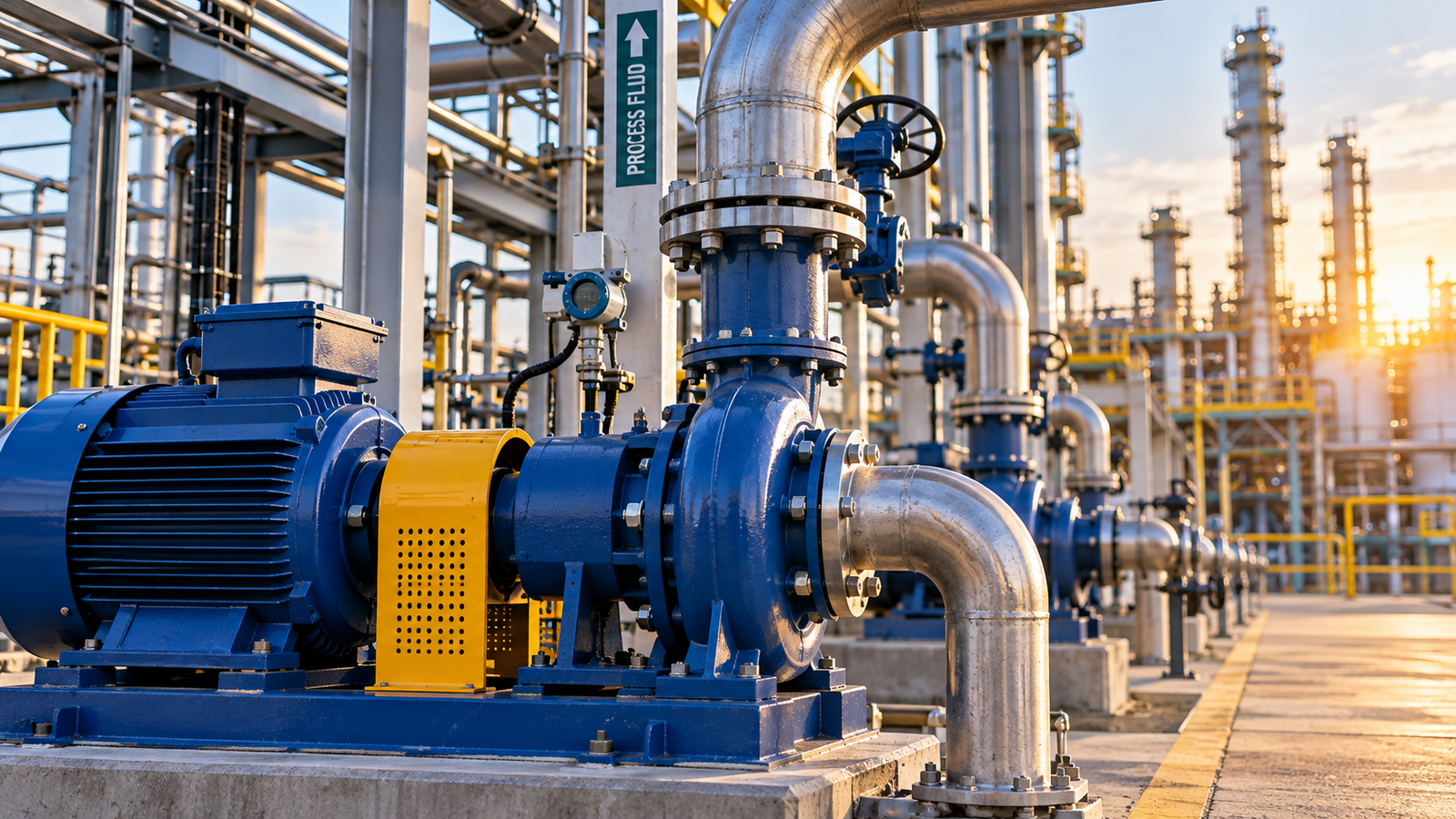
Pumps are among the most widely used pieces of rotating equipment in industrial plants. They move cooling water, hydrocarbons, chemicals, condensate, boiler feedwater and countless other fluids between different parts of the process.
Yet specifying a pump is not simply a matter of knowing the required flow rate.
The fluid, pressure requirement, operating range and installation conditions all influence what type of pump is appropriate for a particular service.
Every pump has a job to perform.
Engineers first need to understand how much liquid must be moved and the pressure or head required to move it through the system.
That duty is influenced by the complete system—including elevation changes, piping resistance, valves, equipment and the required pressure at the destination.
The pump therefore cannot be selected independently of the system in which it will operate.
Water is very different from a viscous oil, corrosive chemical or slurry containing solids.
Important fluid characteristics can include:
These characteristics influence both pump type and materials of construction.
A pump suited to clean water service may be inappropriate for a highly viscous or solids-containing fluid.
Centrifugal pumps are common across process industries because they are well suited to many continuous-flow applications.
Positive-displacement pumps operate differently and can be more suitable for services requiring controlled flow, higher viscosity or particular pressure characteristics.
The choice is therefore driven by the application rather than by which pump type is most familiar.
A pump may need to operate at different production rates during its life.
The selected equipment should therefore be evaluated across the expected operating range rather than only at one design point.
Operating too far from the pump’s intended range can affect efficiency, hydraulic behaviour and equipment condition.
This becomes particularly important where plant production varies significantly.
A pump needs suitable conditions at its inlet.
Poor suction conditions can affect performance and contribute to problems such as cavitation.
Equipment selection therefore needs to consider not only what happens after the pump, but also how liquid reaches it.
Tank level, piping arrangement, temperature and pressure on the suction side can all matter.
Process fluids may require specific materials because of corrosion, temperature or contamination concerns.
Sealing arrangements also need to suit the service and the consequences of leakage.
These decisions become particularly important where fluids are hazardous, valuable or environmentally sensitive.
A pump that meets a flow and pressure requirement on paper is not automatically the right pump.
Engineers also need to consider the fluid, operating range, suction conditions, materials, sealing and interaction with the wider system.
Good pump selection begins with understanding the actual service the equipment will experience, not simply its maximum required capacity.