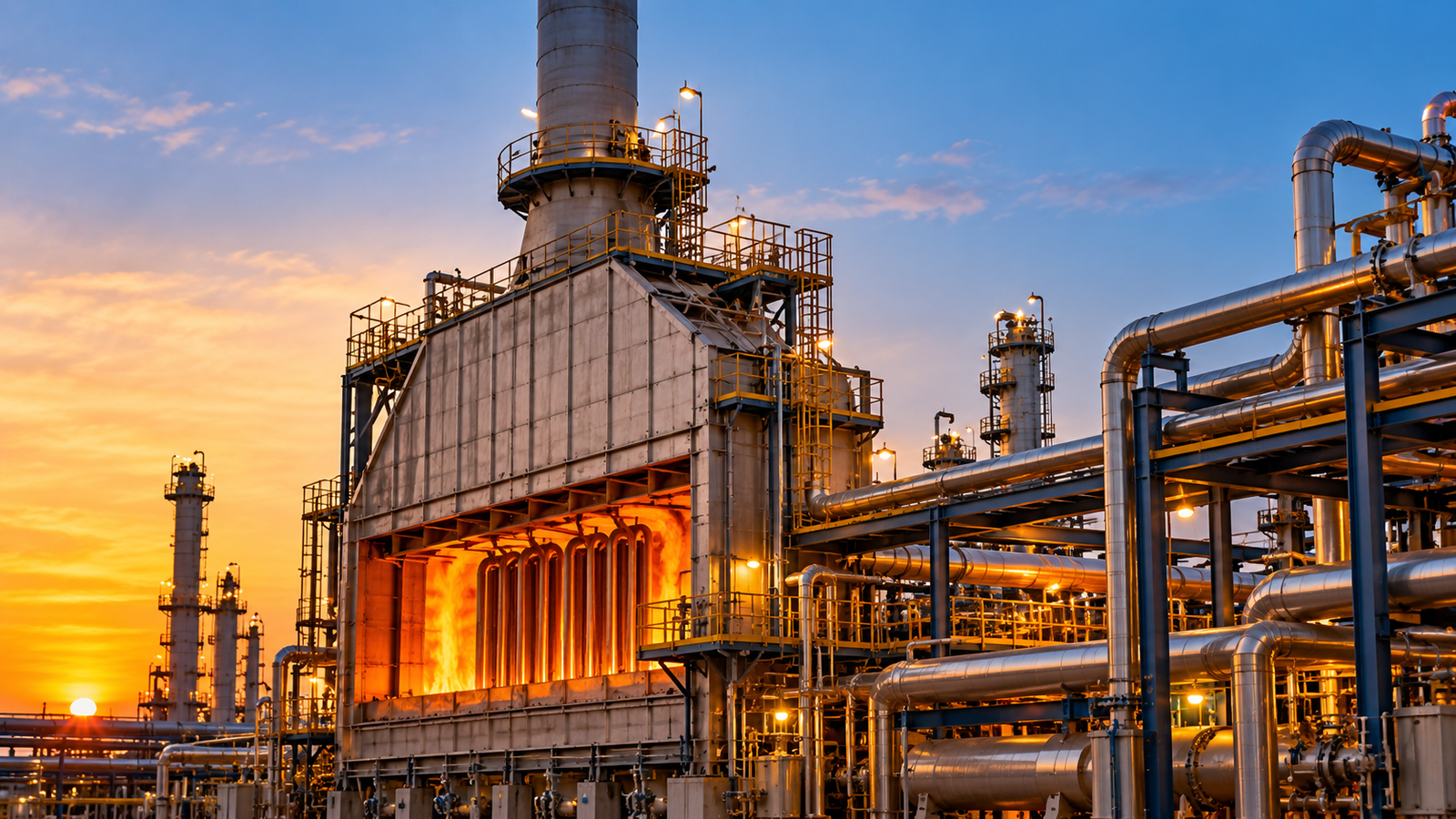
Many industrial processes require temperatures that cannot be achieved economically through steam or conventional heat exchangers alone. In refineries, petrochemical plants and other process industries, fired heaters provide direct high-temperature heating to process fluids.
These heaters transfer energy generated by fuel combustion to tubes carrying the process stream. Their performance has a direct influence on production, energy efficiency, emissions and equipment reliability.
Fired heaters are used when process streams need to be raised to high temperatures before entering another unit operation.
Applications can include:
Although designs vary, the basic principle remains similar: burners generate heat, which is transferred through furnace tubes to the process fluid.
Inside many fired heaters, the process tubes first pass through a radiant section.
This is the hottest area of the heater, where radiant heat from the flame and hot furnace surfaces transfers energy directly to the tubes.
Tube material and operating temperature are critical because the metal must withstand both high temperatures and internal process pressure.
Excessive tube-metal temperature can accelerate material degradation and reduce equipment life.
Hot combustion gases leaving the radiant section still contain significant energy.
Many fired heaters therefore include a convection section where this remaining heat is recovered before the flue gas leaves through the stack.
Process streams, boiler feedwater or combustion air may be heated in this section depending on the heater design.
Effective heat recovery helps improve overall heater efficiency and reduce fuel consumption.
Burners determine how fuel and air are mixed and how combustion takes place inside the heater.
Stable combustion is essential for reliable operation.
Poor burner performance can result in uneven heat distribution, incomplete combustion, excessive emissions or localised overheating of furnace tubes.
Plant operators therefore monitor parameters such as flame condition, fuel pressure, air supply and combustion performance.
Fired heaters rely on controlled movement of combustion gases through the furnace.
The pressure inside the heater is typically maintained slightly below atmospheric pressure to prevent hot gases from escaping through openings in the furnace structure.
Stack draft, dampers and combustion-air systems all influence this balance.
Incorrect draft can affect burner stability, air infiltration and furnace efficiency.
Process tubes operate under demanding conditions because they experience high temperatures while containing pressurised process fluids.
Over time, tubes can be affected by:
Deposits inside process tubes can reduce heat transfer and increase tube-metal temperature because more energy is required to heat the process stream.
Monitoring tube condition is therefore central to fired-heater integrity.
Heater efficiency is influenced by several operating factors.
Excess combustion air, high stack temperature, fouled heat-transfer surfaces and poor burner performance can all increase fuel consumption.
Plants often monitor flue-gas oxygen, stack temperature and fuel usage to assess combustion and thermal performance.
Reducing unnecessary heat losses can improve efficiency without changing the basic process duty.
Fired heaters are normally designed around a defined operating range.
Changes in throughput, feed composition, inlet temperature or required outlet temperature can affect how the heater performs.
Operating significantly away from design conditions may change heat distribution or place additional thermal stress on tubes.
Process and operations teams therefore need to understand how production changes influence furnace duty.
A fired heater is not simply a source of heat.
It is a tightly coupled system involving combustion, heat transfer, process flow, metallurgy, instrumentation and control.
Stable burner operation, controlled draft, clean heat-transfer surfaces and healthy furnace tubes all contribute to reliable operation.
For industrial plants, managing these factors helps maintain the required process temperature while protecting equipment life, controlling fuel consumption and supporting safe operation.