Industrial plants contain many tasks that are repetitive, difficult to access or potentially hazardous.
Robotics is increasingly being explored for these applications.
The objective is not simply to automate for the sake of automation.
The real value comes when robots can reduce exposure, improve consistency or reach areas that are difficult for people to access safely.
Robots can be useful for inspecting:
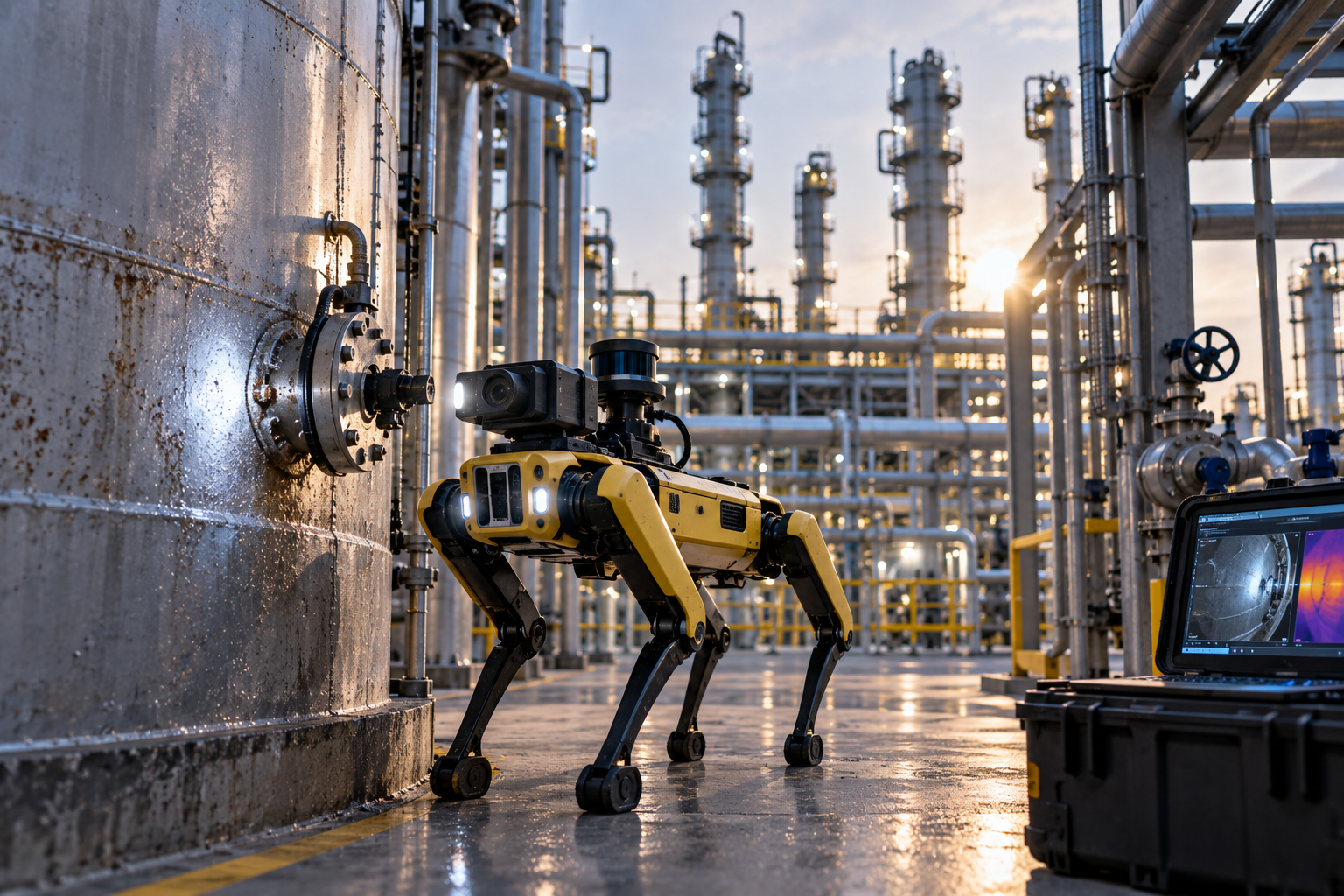
In some applications, robotic systems can carry cameras, ultrasonic sensors or other inspection tools.
This allows condition data to be collected without sending people into difficult environments.
Some industrial tasks involve repeated movement or consistent positioning.
Examples may include:
Robotics can help where the task is structured and predictable.
The strongest case for robotics often appears where human exposure is undesirable.
This may include environments involving:
If a robot can enter first, the plant may reduce the amount of time people spend in high-risk conditions.
Robots work best in controlled environments.
Process plants are often less predictable.
They may contain:
A robot that performs well in a laboratory may need significant adaptation before it can work reliably in a real plant.
Many industrial robots are not fully autonomous.
They may require:
The technology may reduce physical exposure without removing human judgement.
The best applications are not necessarily the most technically impressive.
They are the ones where robotics can make a task safer, more repeatable, more accessible or more efficient.