People | Processes | Performance
inside the industrial plant

Day: September 22, 2026

Maintenance & Reliability

Reliability-Centred Maintenance: Deciding What Maintenance an Asset Actually Needs

Not every asset needs the same level of maintenance. Some equipment is critical to plant safety or production. Other equipment can fail with limited consequence. Reliability-Centred Maintenance, or RCM, provides a structured way to determine what maintenance is appropriate for different assets and failure modes. Start With the Required Function Before deciding how to maintain […]

Maintenance & Reliability

Maintenance Planning and Scheduling: Why Good Work Starts Before the Job

Maintenance quality depends on more than the technician performing the work. Much of the success or failure of a maintenance job is determined before the equipment is touched. Planning and scheduling help ensure that people, tools, parts and access are ready when the work begins. Planning Defines How the Job Will Be Done Maintenance planning […]

Maintenance & Reliability

Condition Monitoring: Turning Equipment Data Into Maintenance Decisions

Condition monitoring allows plants to observe how equipment is behaving while it is operating. The goal is not simply to collect data. It is to identify abnormal conditions early enough to support better maintenance decisions. Different Equipment Produces Different Signals A rotating machine may provide useful information through vibration. A gearbox may reveal deterioration through […]

Maintenance & Reliability

Why Equipment Failure Is Usually a Process, Not a Single Event

When equipment stops working, the failure can appear sudden. A bearing seizes. A pump trips. A seal begins leaking heavily. A motor overheats. But many failures do not begin at the moment the equipment stops. They develop over time. Failure Often Starts Earlier Mechanical deterioration may begin long before operators see an obvious problem. Examples […]

Maintenance & Reliability

Preventive, Predictive and Condition-Based Maintenance: What Changes Between Them

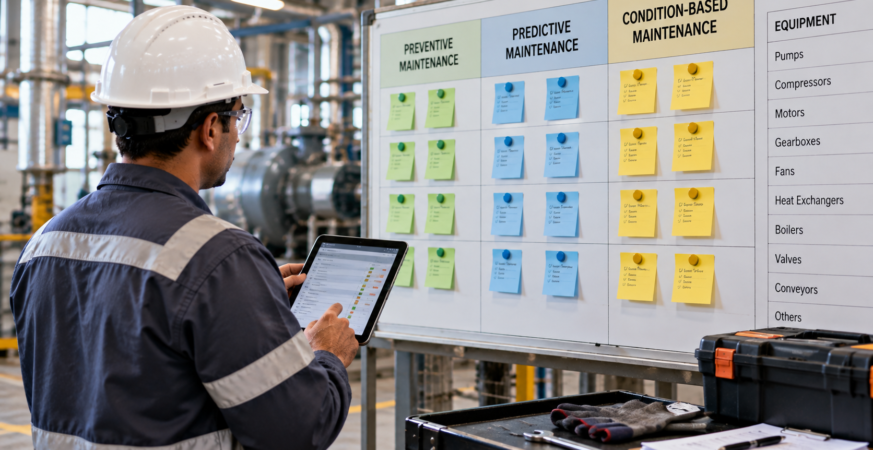
Industrial plants use different maintenance strategies depending on the equipment, its criticality and the consequences of failure. Terms such as preventive, predictive and condition-based maintenance are often used interchangeably, but they are not exactly the same. The key difference is what triggers the maintenance activity. Preventive Maintenance Is Time- or Usage-Based Preventive maintenance is carried […]

Asset Integrity

Mechanical Integrity: Keeping the Pressure Boundary Reliable

Industrial plants depend on piping, vessels, tanks and other equipment to safely contain process fluids. Mechanical integrity is the discipline of ensuring that these assets continue to perform that function throughout their operating life. It brings together design information, inspection, degradation management and repair decisions. Integrity Begins With Knowing the Design Basis Before assessing condition, […]

Asset Integrity

Non-Destructive Testing: Looking for Damage Without Destroying the Equipment

Industrial plants need to understand the condition of equipment without cutting it apart simply to inspect it. Non-Destructive Testing, or NDT, provides techniques for examining materials and components while keeping them usable. Different techniques reveal different types of defects. Visual Inspection Is Often the Starting Point Visual inspection may identify: It is simple but extremely […]

Asset Integrity

Risk-Based Inspection: Why Not Every Asset Needs the Same Inspection Frequency

Industrial plants may contain thousands of piping circuits, vessels, tanks and other inspectable assets. Treating every item as equally important is neither practical nor necessarily effective. Risk-Based Inspection, or RBI, helps plants focus inspection effort where failure could matter most. Risk Combines Probability and Consequence The basic concept is straightforward: Risk = likelihood of failure […]

People | Processes | Performance

inside the industrial plant 

© 2026 The Plant Insider. All rights reserved.