Inside a Process Plant: How Piping Systems Move Materials
Piping systems are the circulatory network of a process plant. They transport raw materials, intermediate products, finished products and utility fluids between different areas and equipment.
Without a properly designed and maintained piping system, continuous plant operations would not be possible.
The Role of Piping in a Plant
Piping connects equipment such as reactors, heat exchangers, pumps, compressors, tanks, columns and vessels.
Depending on the application, pipes may carry liquids, gases, steam, chemicals, cooling water, fuel and other process or utility fluids.
The piping system must deliver the right material to the right equipment at the required pressure, temperature and flow conditions.
It also provides connections for isolation, control, draining, venting and maintenance.
Different Types of Piping
A process plant can have several types of piping systems, including:
- Process piping: Carries materials directly involved in production.
- Utility piping: Carries services such as steam, cooling water, compressed air and fuel gas.
- Instrument piping: Connects instruments and control systems.
- Drain and vent piping: Removes liquids or gases from equipment and piping systems.
- Firewater piping: Supplies water for fire protection systems.
Each service has different operating and design requirements.
What Goes Into a Piping System?
A piping system is much more than the pipe itself.
Important components include:
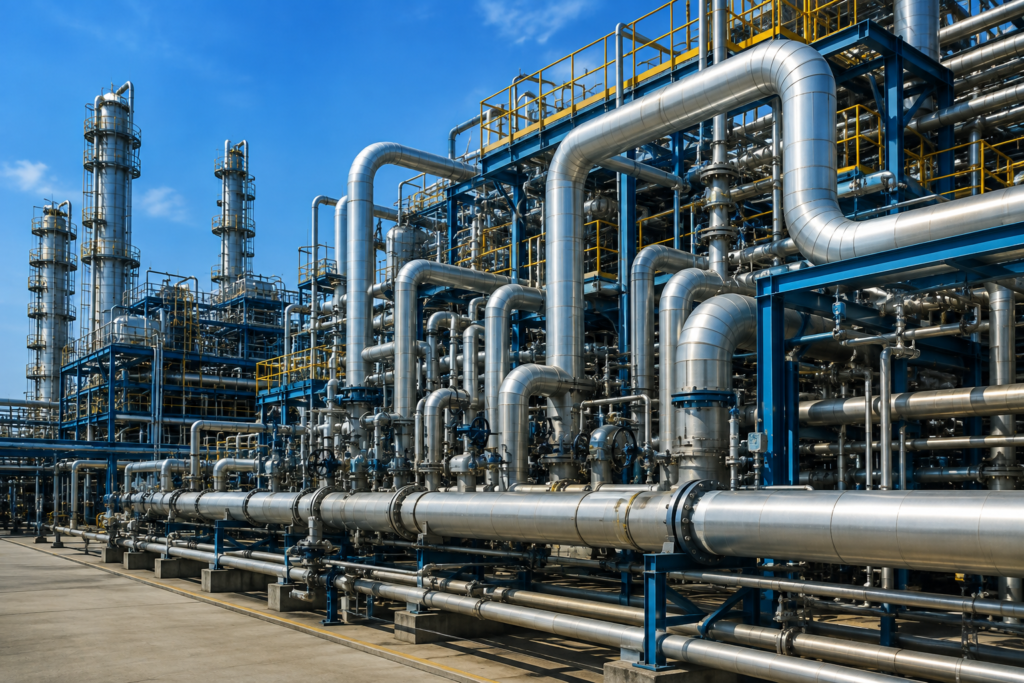
- Pipes
- Fittings and elbows
- Flanges
- Valves
- Gaskets and bolting
- Pipe supports and hangers
- Expansion joints where required
- Drains and vents
- Insulation and protective systems
Together, these components create a network capable of operating under the pressures, temperatures and environmental conditions found in an industrial plant.
Design Considerations
Piping design involves several engineering considerations.
Engineers need to consider the properties of the fluid, operating pressure and temperature, required flow rate, pipe size, material compatibility, corrosion, vibration and thermal expansion.
Pipe routing is also important. Systems must be accessible for inspection and maintenance while fitting within the available plant layout.
Applicable engineering codes and standards also guide the selection of materials, design, fabrication, inspection and testing.
Managing Pressure, Flow and Temperature
A piping system must maintain the required operating conditions as the fluid moves through the plant.
Pressure drop can occur because of pipe length, fittings, valves and changes in elevation. Pipe size and routing therefore need to be considered carefully.
Valves and other flow-control equipment help operators regulate, isolate or redirect flow.
For high- or low-temperature services, insulation, expansion provisions and appropriate materials may also be required.
Piping Integrity and Reliability
Piping operates continuously and can be exposed to corrosion, erosion, vibration, thermal cycling and mechanical stresses.
Over time, these conditions can affect pipe walls, welds, joints, supports and other components.
Inspection and maintenance programmes help identify deterioration before it develops into a leak or failure.
Depending on the service and plant requirements, inspection may include visual examination, thickness measurements, non-destructive testing and other integrity-assessment methods.
Why Piping Matters
Piping may not receive the same attention as major process equipment, but it connects almost everything inside a plant.
A well-designed and maintained piping system supports safe material movement, reliable production and efficient plant operation.
When piping integrity is compromised, the consequences can range from leaks and environmental releases to equipment damage and unplanned shutdowns.
In a process plant, reliable piping is fundamental to keeping materials moving and the plant running.