Valves are present throughout almost every industrial plant. They control, isolate, divert or regulate the movement of liquids, gases and other process fluids through piping systems.
Although relatively small compared with major process equipment, valves play an important role in plant operation, safety and maintenance.
What Do Valves Do?
The basic function of a valve is to control fluid flow.
Depending on the application, a valve may be used to:
- Start or stop flow
- Regulate flow
- Control pressure
- Prevent reverse flow
- Divert flow between different lines
- Isolate equipment for maintenance
- Provide protection during abnormal operating conditions
The correct valve depends on the service, including the fluid being handled, pressure, temperature, flow requirements and frequency of operation.
Common Valve Types
Industrial plants use many different valve designs.
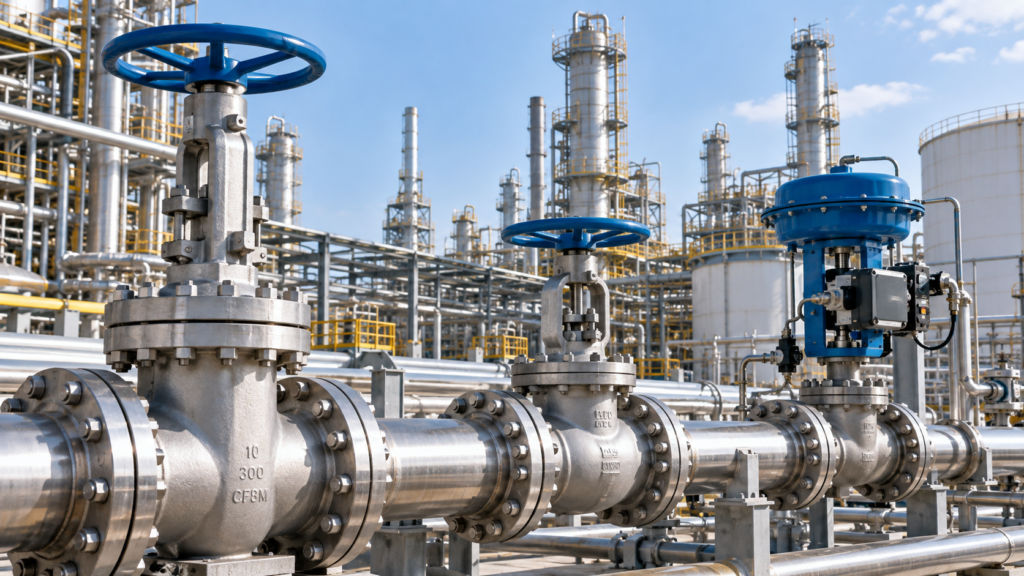
Gate valves are commonly used for isolation and are generally intended to be fully open or fully closed.
Globe valves can be used for regulating flow because their design allows more controlled adjustment.
Ball valves provide quick shut-off and are widely used where tight isolation is required.
Butterfly valves are often used on larger-diameter pipelines because they are relatively compact and lightweight.
Check valves allow flow in one direction and help prevent reverse flow.
Other specialised valves are selected for particular pressure, temperature, material or safety requirements.
Valves Across the Plant
Valves can be found in process lines, utility systems, storage areas and equipment connections.
They may be installed around pumps, compressors, heat exchangers, tanks, reactors and other equipment.
In a typical system, several valves may perform different functions. One valve may isolate equipment, another may control flow, while another protects the system from reverse flow or excessive pressure.
Manual and Automated Valves
Some valves are operated manually by plant personnel.
Others are fitted with actuators that allow them to be operated remotely or automatically.
Automated valves can receive signals from the plant's control system and respond to changing process conditions.
Actuation may be pneumatic, electric or hydraulic, depending on the application.
For critical services, the valve and actuator must be considered together as a complete operating system.
Choosing the Right Valve
Valve selection is not simply a matter of choosing the correct pipe size.
Engineers consider factors such as:
- Fluid properties
- Pressure and temperature
- Required flow
- Valve material
- Corrosion and erosion
- Leakage requirements
- Operating frequency
- Actuation requirements
- Maintenance and accessibility
A valve suitable for water service, for example, may not be appropriate for a high-temperature, corrosive or hazardous process fluid.
Valve Reliability and Maintenance
Valve problems can affect both production and safety.
Common issues include leakage, corrosion, damaged seals, actuator problems, sticking and incorrect operation.
Regular inspection and maintenance can help identify problems before they lead to process disruption.
For valves that are rarely operated but are required during an emergency, periodic testing is particularly important.
The Importance of Isolation
One of the most important functions of valves is allowing equipment and sections of piping to be isolated.
Before maintenance, repair or inspection, the relevant equipment may need to be separated from operating systems and made safe according to the plant's procedures.
Proper valve identification, accessibility and operating procedures are therefore important parts of plant maintenance and safety.
The Bottom Line
Valves are fundamental components of industrial piping systems.
They may control only a small part of a plant's overall flow network, but their performance can influence equipment operation, maintenance activities, process control and safety.
A reliable valve is not just a flow-control component—it is an essential part of keeping the plant operating safely and continuously.