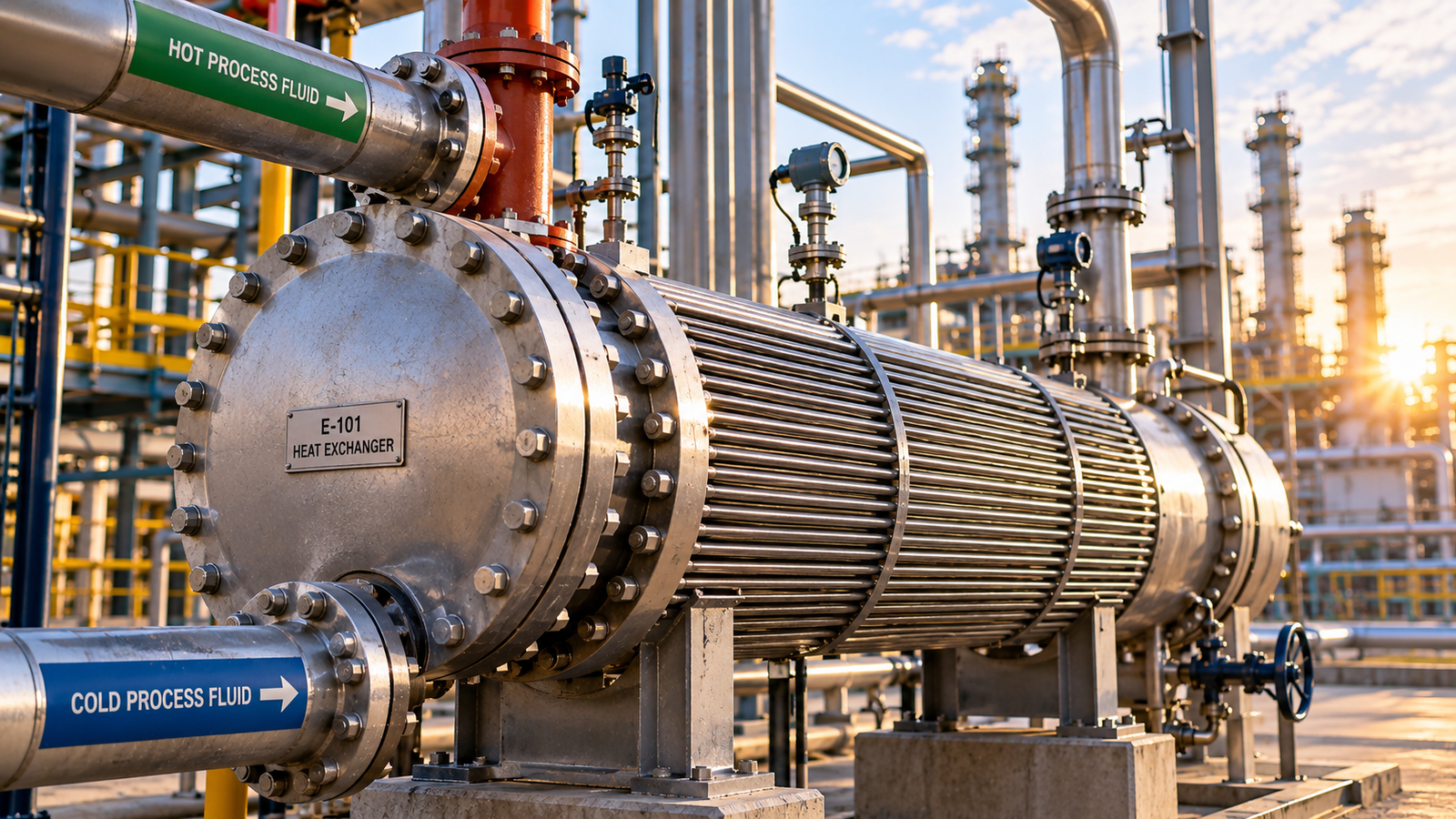
Heat exchangers allow industrial plants to transfer heat from one fluid to another without necessarily mixing the two streams.
They are used for heating, cooling, condensing, vaporising and recovering energy throughout process plants.
But “heat exchanger” describes a broad family of equipment.
The appropriate configuration depends on much more than the amount of heat that needs to be transferred.
The basic requirement is to understand how much heat must be transferred and the inlet and outlet conditions of both streams.
But the temperature difference available between the fluids also matters.
Some duties are relatively straightforward. Others involve close temperature approaches or changing phases, creating different equipment requirements.
Shell-and-tube exchangers are widely used in process industries, but plate-type and other exchanger configurations can be attractive depending on the service.
Different designs offer different combinations of:
The “best” exchanger therefore depends on the operating environment.
Many process fluids leave deposits on heat-transfer surfaces over time.
Fouling reduces thermal performance and can increase pressure drop.
For services where fouling is expected, engineers need to think about more than initial clean-condition performance.
Cleaning method, accessibility and allowable degradation between cleaning intervals become important considerations.
Heat transfer can often be improved by increasing fluid velocity, but higher velocity can also increase pressure drop.
That additional pressure loss may increase pumping or compression requirements elsewhere in the plant.
Heat-exchanger design therefore involves a balance between thermal performance and hydraulic impact.
Heat exchangers often handle two different fluids separated by a relatively thin metal surface.
Material selection therefore needs to consider the conditions on both sides.
Corrosion, temperature, compatibility and the consequences of leakage between streams can all influence the choice.
Eventually, many exchangers will need inspection or cleaning.
Plant layout should therefore allow realistic access to the equipment.
A design that performs well thermally but cannot be conveniently opened, cleaned or serviced may create difficulties later.
Heat-exchanger engineering brings several requirements together:
thermal duty, pressure drop, materials, fouling behaviour, mechanical design and maintainability.
The equipment must transfer the required heat—but it must also remain practical throughout its operating life.