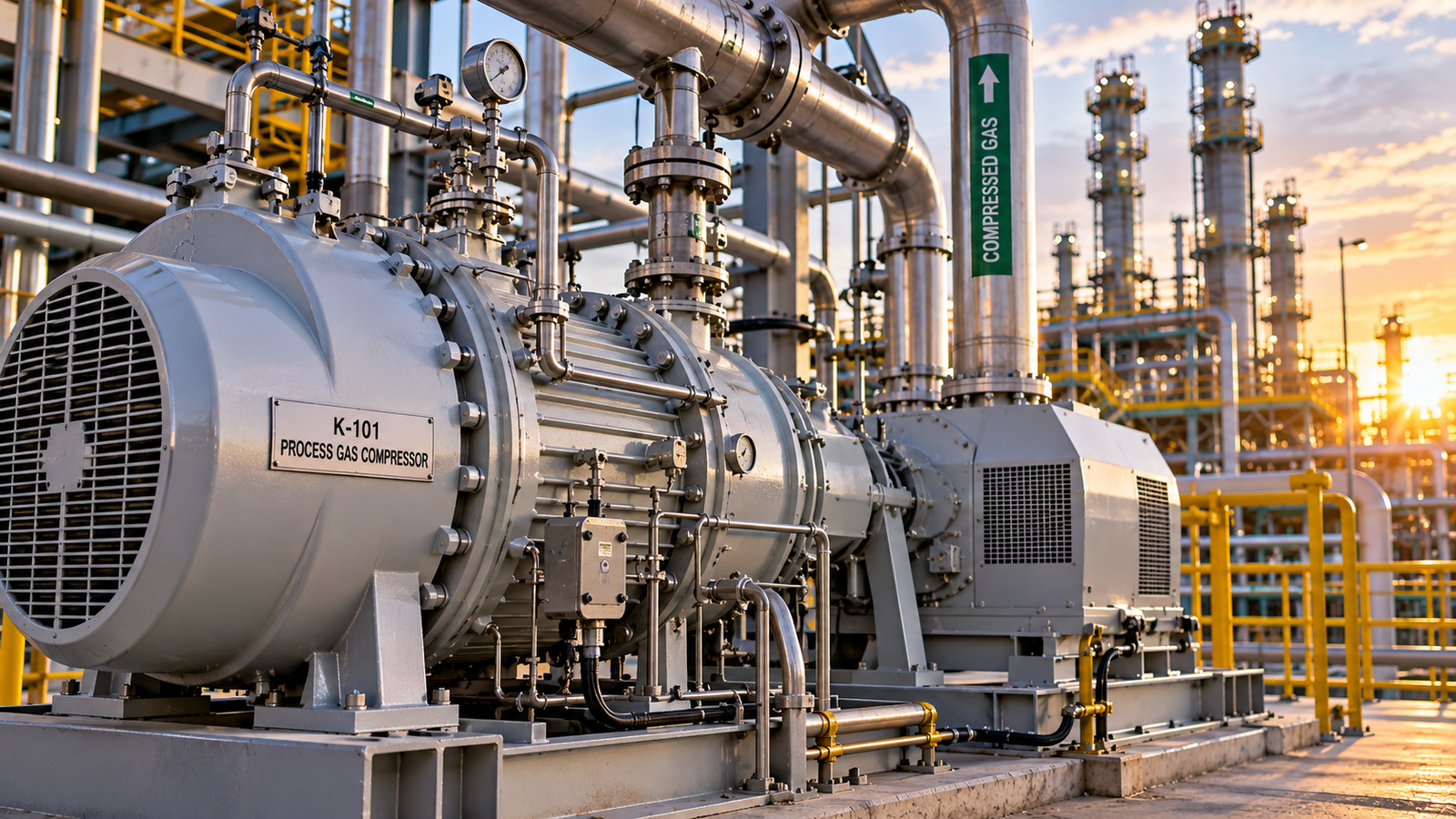
Compressors perform a role for gases that is broadly comparable to the role pumps perform for liquids: they increase pressure and move the process fluid through the system.
But gas compression introduces its own engineering challenges.
Gases change density significantly as pressure and temperature change, and compression itself generates heat.
This makes compressor selection closely tied to the characteristics of the gas and the required operating duty.
Gas composition affects many aspects of compressor design.
Engineers may need to consider:
Changes in gas composition can also affect equipment performance.
A compressor therefore needs to be selected for the actual gas service—not simply a nominal flow rate.
The difference between suction and discharge conditions is fundamental.
Some applications require relatively modest pressure increases, while others need multiple stages of compression.
The required pressure ratio influences compressor configuration, number of stages and cooling requirements.
Centrifugal compressors are commonly used for large continuous gas flows.
Reciprocating compressors can be appropriate where higher pressure ratios, lower flows or particular operating characteristics are required.
Other compressor technologies serve additional specialised duties.
The correct choice depends on the service rather than one technology being universally superior.
Compressing gas increases its temperature.
That temperature rise can influence equipment materials, lubrication, downstream process conditions and the need for intercooling or aftercooling.
For multistage compression, cooling between stages can become an important part of the system.
Plants do not always operate at one production rate.
Compressors may therefore need to perform across a range of flows.
How the equipment responds at reduced or increased demand can influence both performance and control strategy.
For centrifugal machines in particular, operating limits need to be understood when defining the expected operating envelope.
The compressor is normally supported by additional systems such as:
Its performance is therefore connected to more than the compressor casing itself.
Compressor engineering requires a clear understanding of gas composition, flow, pressure ratio, temperature and operating range.
This is why gas compression should be treated as a specific equipment problem rather than simply applying liquid-pumping logic to a gas service.