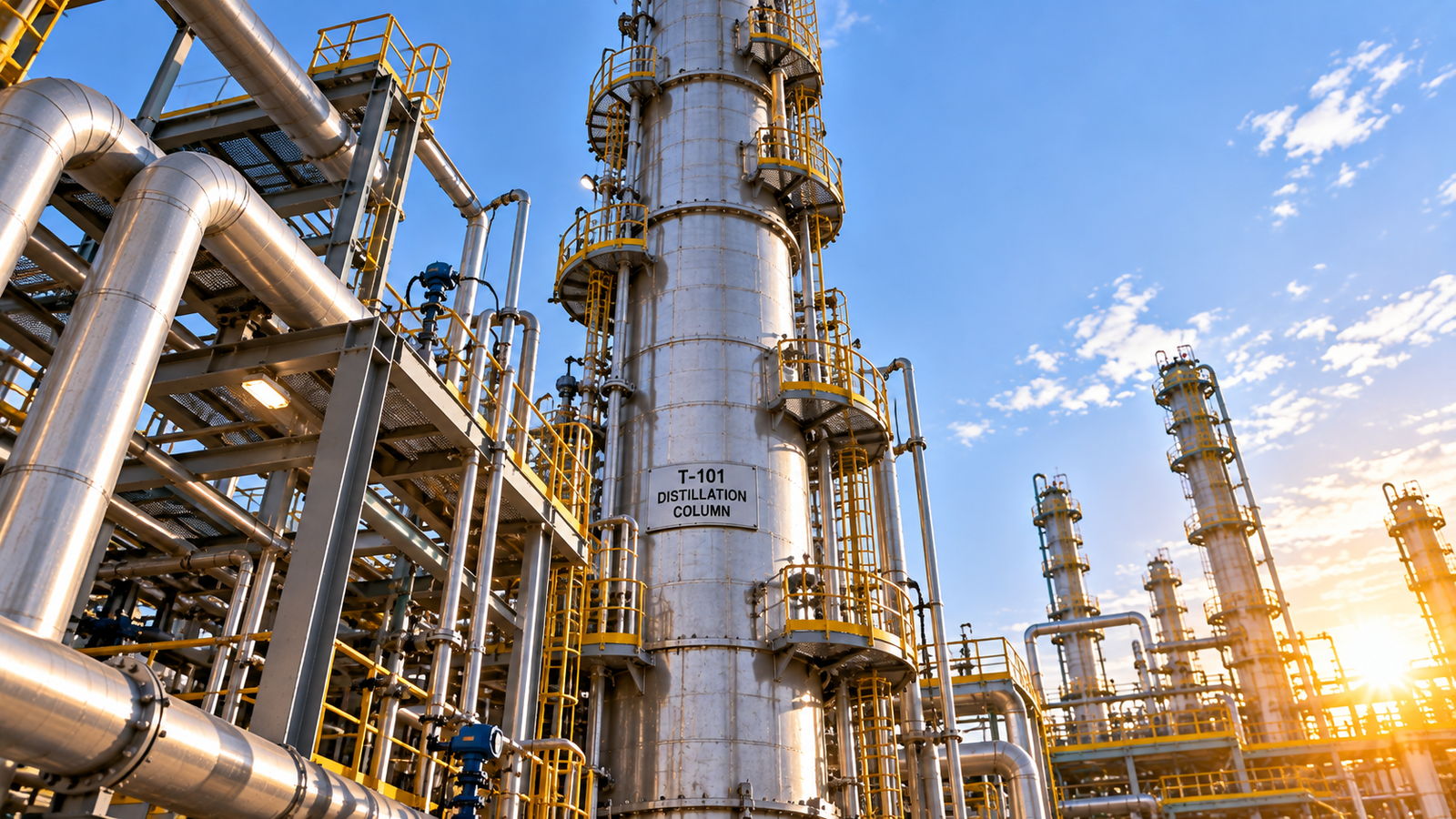
Many process industries need to separate mixtures into different components.
Distillation columns, absorbers, strippers and other towers provide the physical equipment in which many of these separations take place.
The process determines what separation is required.
The equipment then has to provide the environment in which that separation can occur reliably.
A tall cylindrical vessel is only the visible part of the equipment.
Inside the column may be trays, structured packing, random packing, distributors and other internals.
These components create contact between phases and strongly influence how effectively the separation takes place.
The selection and arrangement of internals therefore form an important part of column engineering.
As flow through a column changes, conditions inside the equipment also change.
Vapour and liquid need sufficient contact for separation, but excessive loading can create hydraulic limitations.
Pressure drop, liquid distribution and vapour flow therefore influence the operating capacity of the column.
Equipment design needs to provide an appropriate operating window rather than simply accommodate one theoretical flow rate.
Some columns operate under pressure, while others operate under vacuum.
Operating pressure affects both process behaviour and mechanical design.
Vacuum systems can introduce particular mechanical considerations because the vessel must withstand external pressure conditions.
Where packing is used, poor liquid distribution can reduce the effective performance of the equipment.
Distributors and redistributors therefore become important internal components.
Similarly, tray performance depends on appropriate vapour and liquid interaction.
The quality of the internals can strongly influence whether the equipment achieves the intended separation.
Column internals may eventually require inspection, cleaning or replacement.
Manways and access arrangements therefore need to support these activities.
For large towers, maintenance planning and internal access can become significant practical considerations.
Columns illustrate particularly well the distinction between Process Engineering and Equipment.
Process Engineering determines the separation requirements and operating conditions.
Equipment Engineering turns those requirements into a physical vessel with appropriate dimensions, internals, materials and access.
The two disciplines work together—but they answer different engineering questions.