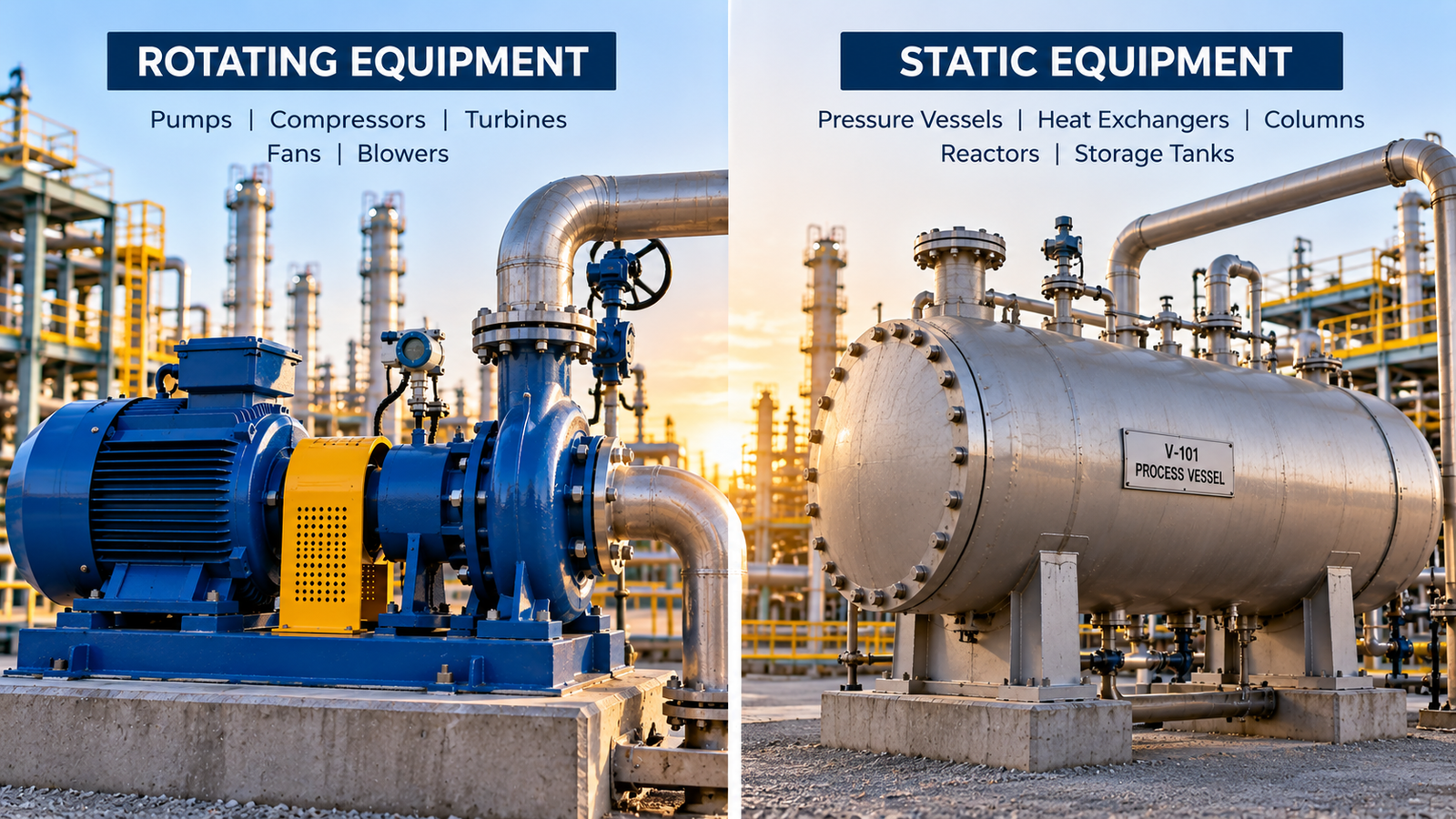
Industrial plants contain a huge variety of equipment, but one useful broad distinction is between rotating equipment and static equipment.
Rotating equipment contains moving components that perform mechanical work.
Static equipment generally performs its duty without major rotating machinery.
Both are essential, but their engineering priorities can differ significantly.
Typical rotating equipment includes:
These machines depend heavily on mechanical movement.
Speed, vibration, bearings, seals, alignment and interaction with the driver become important parts of equipment design and performance.
Dynamic behaviour therefore matters considerably.
Static equipment can include:
These assets generally do not rely on major rotating assemblies to perform their primary duty.
Instead, their design tends to focus more heavily on containment, pressure, temperature, materials, structural behaviour and internal process requirements.
Rotating equipment interacts strongly with foundations, drivers and connected piping.
Piping loads and alignment can influence equipment behaviour.
Static equipment may involve larger numbers of nozzles, internal components and structural interfaces.
Large vessels and tanks can also create substantial foundation and layout requirements.
The distinction continues after commissioning.
Rotating machinery often requires attention to lubrication, vibration, seals, bearings and alignment.
Static equipment integrity may focus more on corrosion, wall thickness, cracking and internal inspection.
Those maintenance subjects belong under TPI’s Maintenance section, but the difference begins with how the equipment itself is engineered.
A process unit may depend on both static and rotating equipment performing together.
A vessel may feed a pump.
A compressor may send gas to a heat exchanger.
A column may depend on pumps, reboilers and condensers around it.
The classification is therefore useful for understanding engineering priorities, not for separating equipment into unrelated systems.
Rotating and static equipment ultimately serve the same plant.
But the physical principles governing them are different.
Recognising those differences helps explain why equipment engineering is a substantial discipline in its own right—and why a plant’s machinery and stationary equipment require different design expertise.