Industrial plants often operate for decades.
Equipment manufacturers do not always support individual product ranges for the same length of time.
As a result, plants eventually face a common problem:
This is especially common with electrical, electronic and control equipment.
A component may move through several stages:
If the plant recognises these stages early, it has more options.
If the issue is discovered only after failure, the sourcing problem becomes much more difficult.
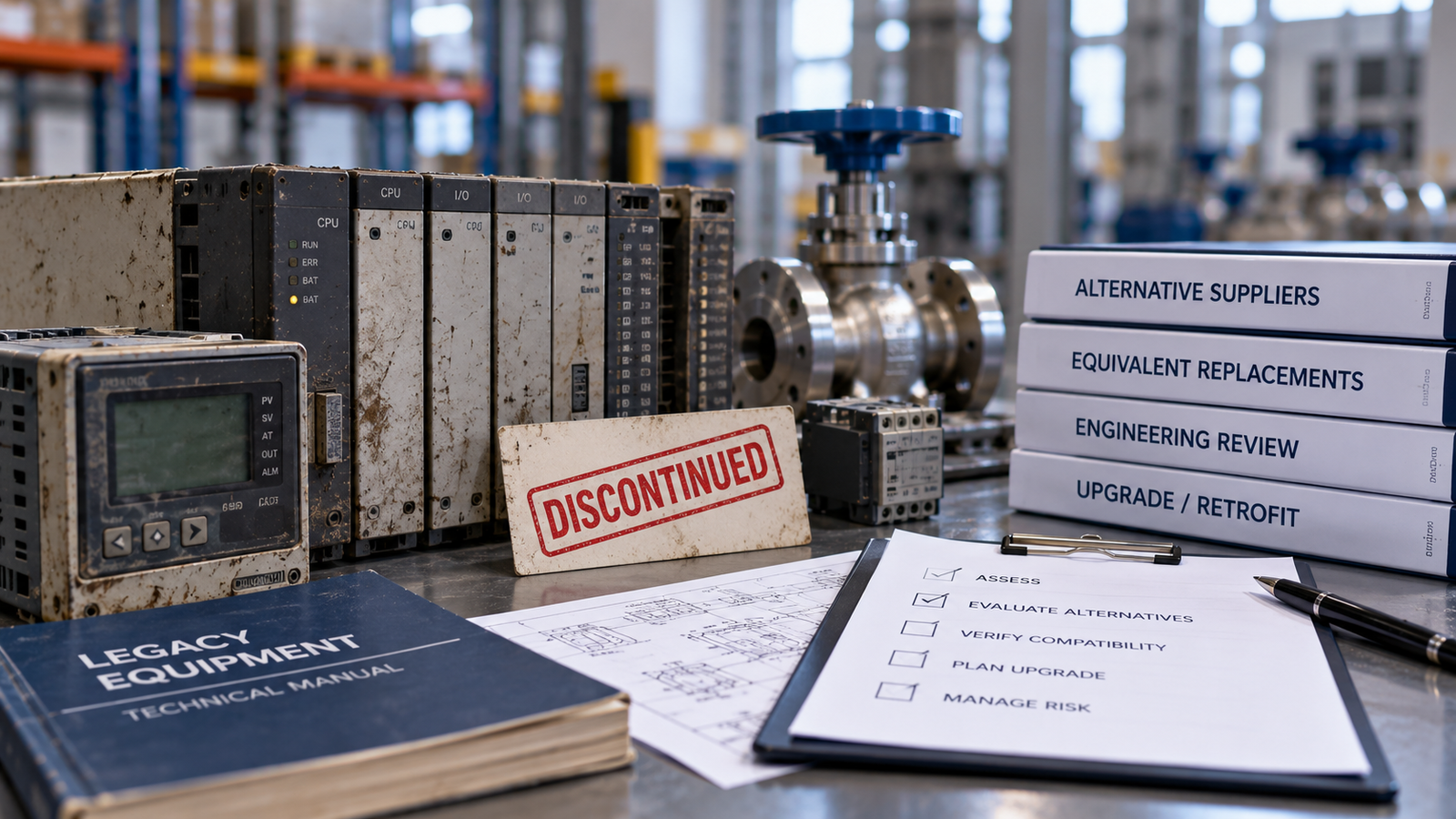
Older plants may still operate:
These systems may continue operating reliably for years, but replacement becomes harder when failure occurs.
Sometimes equivalent parts remain available from:
However, compatibility needs careful verification.
A physically similar part may not be technically equivalent.
Replacement items may differ in:
Engineering teams therefore need to assess whether a proposed substitute is suitable for the actual service.
At some point, repeatedly searching for obsolete components may become inefficient.
A plant may decide to:
The decision depends on technical risk, lifecycle cost and future supportability.
The strongest approach is proactive.
Plants can identify vulnerable components early, determine replacement options and create migration plans before emergency sourcing becomes necessary.
Obsolescence is not simply a procurement inconvenience.
It is a lifecycle risk.
Managing it early gives the plant time to choose the best technical and commercial solution instead of accepting whatever is available during a breakdown.