Mixing is a common operation across chemical, pharmaceutical, food, water-treatment and many other industrial plants. Although an agitator may appear to be a relatively simple piece of rotating equipment, its performance depends heavily on how well the mixer is matched to the process duty.
The objective may be to blend two liquids, keep solids suspended, improve heat transfer, disperse gas, maintain product uniformity or support a chemical reaction. Each of these duties can require a different approach to equipment selection and operation.
The starting point for selecting a mixer is understanding what the process is expected to achieve.
A tank that only needs gentle blending may require relatively low power. A vessel handling high-viscosity material, solids or gas dispersion may require a very different impeller, speed and drive arrangement.
Process engineers typically consider factors such as:
A mixer that performs well in one service may be unsuitable for another.
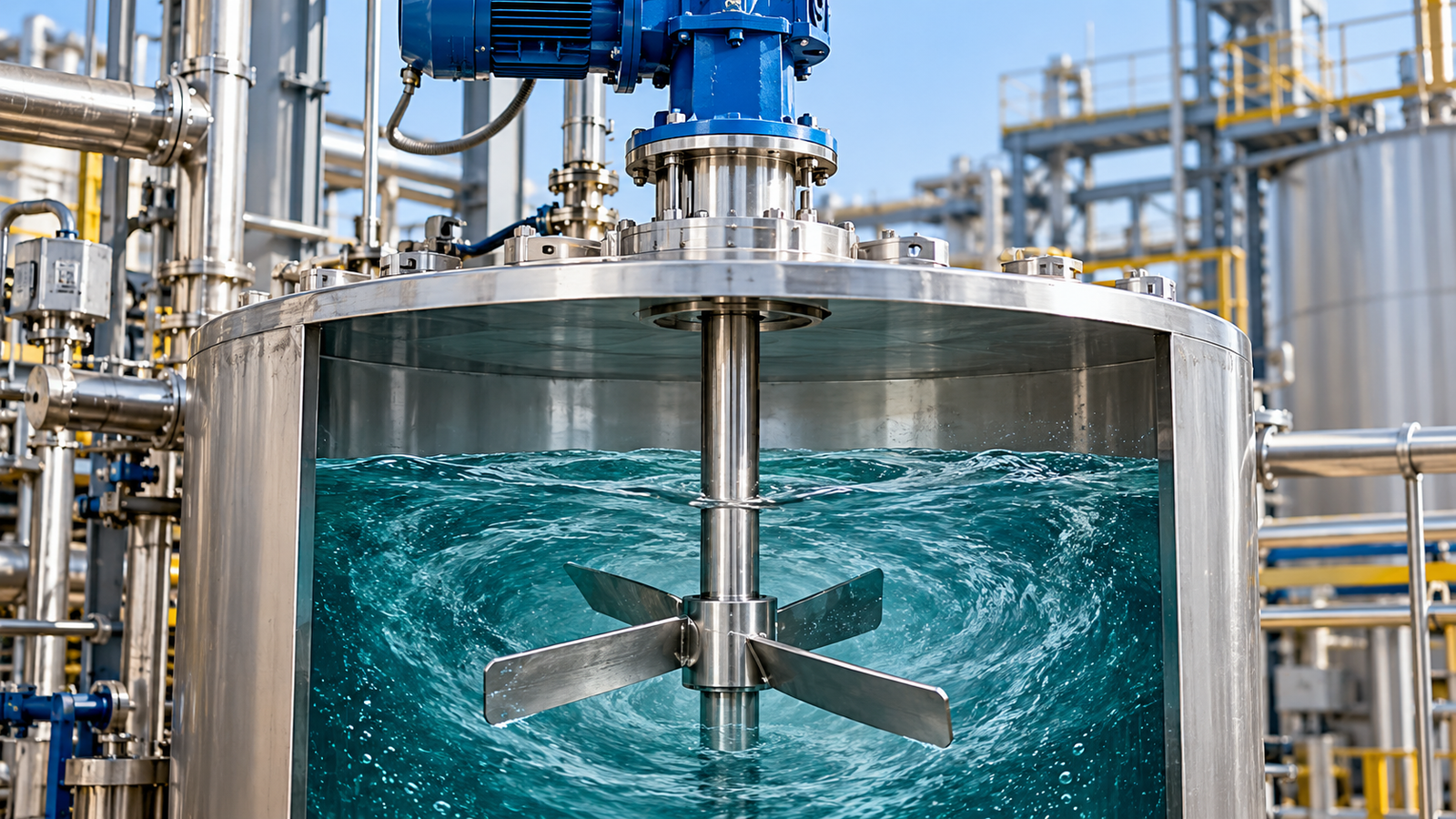
The impeller is one of the most important elements of a mixing system because it determines how energy is transferred into the fluid.
Different impeller designs create different flow patterns. Some primarily move liquid axially through the tank, while others generate more radial movement.
The choice depends on the process requirement. Blending low-viscosity liquids, suspending solids and dispersing gas may each favour different impeller characteristics.
Diameter, blade geometry and position within the vessel also influence circulation and mixing effectiveness.
Higher mixer speed does not automatically mean better process performance.
Increasing speed raises power consumption and can increase mechanical loads on the shaft, bearings and gearbox. In some processes, excessive agitation can also create undesirable shear, entrain air or affect product quality.
The goal is therefore not maximum agitation, but sufficient energy input to achieve the required process result reliably and efficiently.
Mixer performance is closely linked to the vessel itself.
Tank diameter, liquid height, bottom shape and the location of internal equipment can all influence fluid movement.
Baffles are commonly installed inside tanks to reduce swirling and encourage more effective circulation. Without suitable baffling, a rotating impeller can sometimes cause the liquid to rotate largely as a single mass rather than mix effectively throughout the vessel.
The interaction between the agitator and the tank design therefore needs to be considered as a complete system.
Agitators may operate continuously for long periods, so mechanical reliability is important.
The shaft, bearings, gearbox, coupling and seal system must withstand the operating loads generated by the process. Changes in viscosity, solids concentration or liquid level can alter these loads significantly.
Vibration, misalignment, seal leakage and gearbox problems can all affect equipment availability.
For plant teams, monitoring these components is an important part of maintaining reliable mixer performance.
A mixer that was correctly selected for the original process may become less suitable if production conditions change.
Higher batch volumes, increased solids content, changes in viscosity or modifications to the formulation can alter the mixing requirement.
If product quality or mixing time begins to change, the issue may not always be mechanical. The operating duty itself may have moved away from the conditions for which the equipment was originally designed.
Mixing equipment influences more than movement inside a tank.
Poor mixing can affect reaction performance, temperature uniformity, product consistency, solids suspension and downstream processing.
Matching the agitator, impeller and drive system to the actual process duty helps plants achieve the required mixing performance while limiting unnecessary power consumption and mechanical stress.
For plant engineers, the key is to treat the mixer as part of the process rather than simply as a motor and shaft attached to a vessel.