Industrial plants depend on control loops to keep process conditions within the range required for safe, stable and efficient operation.
Pressure, temperature, flow and level are constantly changing as feed rates vary, equipment performance shifts and disturbances move through the process.
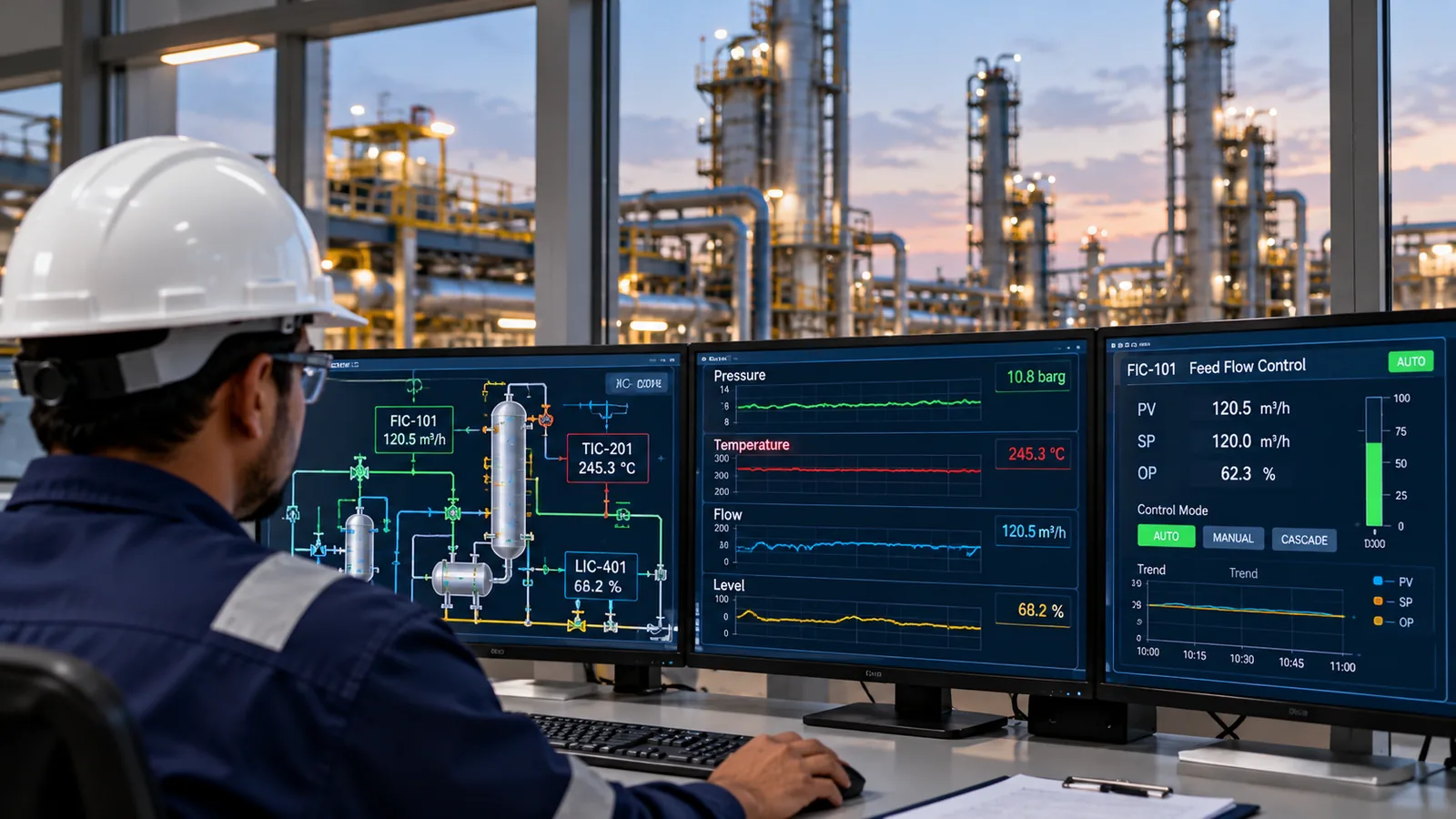
A control loop responds to these changes by measuring the process, comparing the measurement with a target and adjusting a final control element such as a valve, damper or variable-speed drive.
But stable control depends on much more than simply connecting an instrument to a controller.
Before a control loop is designed, engineers need to understand what the process variable represents and why it needs to be controlled.
A flow controller may be used to maintain production rate.
A temperature controller may protect product quality or equipment.
A level controller may maintain inventory inside a vessel.
A pressure controller may help keep an entire process system within its operating envelope.
The control strategy therefore begins with the process objective, not with the controller itself.
The controller can only respond to the information it receives.
If the measurement is slow, unstable or located in the wrong place, the control loop may perform poorly even when the controller is correctly configured.
Engineers therefore consider factors such as:
A temperature sensor installed too far from the critical process location, for example, may respond only after the actual process has already changed significantly.
Once the controller decides that a correction is needed, something has to physically change the process.
This is usually achieved through a final control element such as:
If the final element is oversized, slow, poorly selected or mechanically unstable, the loop may struggle to maintain the required condition.
Control performance therefore depends on the complete loop rather than the controller alone.
Different processes respond at very different speeds.
A flow system may react almost immediately when a valve moves.
A large vessel temperature may take several minutes to change.
A level in a storage tank may change even more slowly.
These differences are known as process dynamics.
The controller needs to respond in a way that matches the behaviour of the process.
If it reacts too aggressively, the process may oscillate.
If it responds too slowly, the variable may remain away from the desired condition for too long.
Dead time is the delay between making a change and seeing its effect in the measurement.
It can arise from:
Long dead time makes control more challenging because the controller does not immediately know whether its previous action was sufficient.
If it continues making corrections before the earlier response becomes visible, the loop can overshoot or become unstable.
Understanding dead time is therefore important when designing and tuning control strategies.
The setpoint is the target value the controller tries to maintain.
Selecting the setpoint is a process-engineering decision.
It needs to consider:
Operating very close to a constraint may increase throughput, but it can also reduce the margin available to absorb disturbances.
The best operating point is therefore not always the maximum achievable value.
Industrial processes are highly connected.
Changing one variable can influence several others.
For example, increasing feed flow may affect vessel level, heat duty, pressure and downstream composition.
Multiple controllers may then respond at the same time.
If these interactions are not understood, one control loop can interfere with another.
This is particularly important in tightly integrated process units where changes propagate quickly through connected equipment.
Process engineers therefore need to look at the plant as a system rather than evaluating every loop independently.
A process variable that repeatedly moves above and below its setpoint may indicate poor controller tuning.
But tuning is not always the only cause.
Oscillation can also result from:
Simply adjusting controller parameters without identifying the underlying cause may only mask the problem.
Stable operation requires both control-system performance and healthy process equipment.
Poor control can have wider operational consequences.
Variability in process conditions can influence:
A process may technically remain within allowable limits but still operate inefficiently if control variability is high.
Reducing unnecessary variation can therefore create value even when no major process modification is required.
A control loop designed for the original plant may not remain optimal forever.
Plants change.
Throughput increases, feed composition changes, equipment is modified and operating targets evolve.
A loop that performed well at one production rate may behave differently after a major capacity increase.
Process engineers should therefore revisit control strategies when operating conditions move significantly away from the original design basis.
Some plants use advanced process control, model-based control or optimisation systems to coordinate multiple variables.
These technologies can help manage complex interactions and push the plant closer to operating constraints.
But advanced control still depends on strong basic control.
If measurements are unreliable, valves are sticking or fundamental control loops are unstable, adding a more sophisticated supervisory layer will not solve the underlying problem.
Basic loop performance remains the foundation.
Control loops sit at the interface between process design and real plant operation.
They translate engineering intent into continuous adjustments that keep the process stable as conditions change.
Good control starts with understanding the process objective, selecting meaningful measurements, choosing suitable final control elements and recognising how the process responds over time.
For process engineers, control is therefore not simply an instrumentation function.
It is one of the ways the process design continues to operate in the real plant every minute of the day.