Every process plant handles flows of materials and energy.
Raw materials enter, products and by-products leave, utilities provide heating or cooling, and energy is transferred throughout the process.
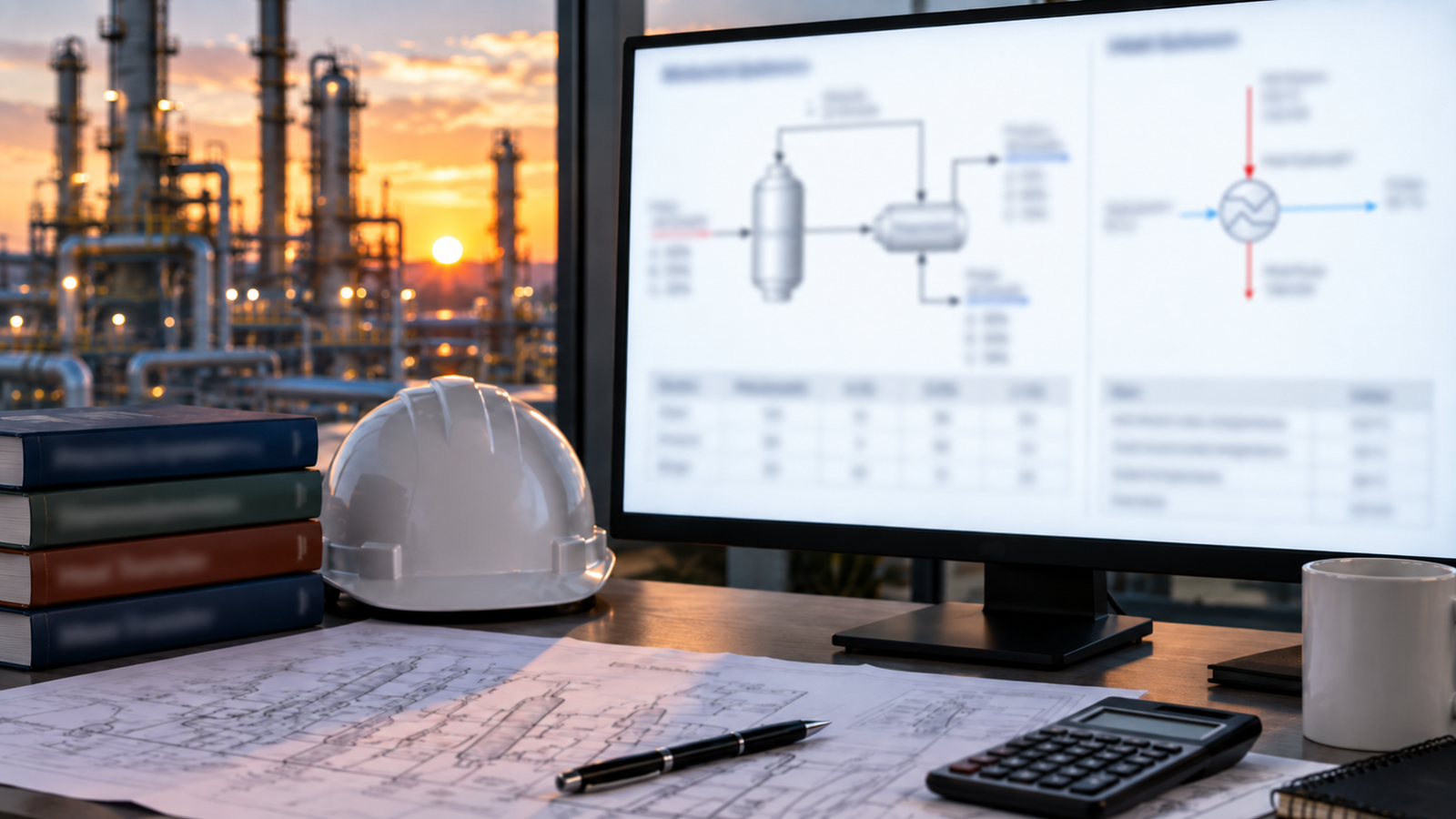
A heat and material balance provides engineers with a structured way to understand these movements.
It is one of the fundamental tools of process engineering.
A material balance accounts for the material entering and leaving a process.
At its simplest, the principle is straightforward:
Engineers use material balances to understand feed rates, product rates, recycle streams, losses and changes in composition.
In a continuously operating process under stable conditions, accumulation may be very small or effectively zero. In batch or changing operations, accumulation becomes an important part of the calculation.
Industrial processes rarely involve only one material.
Feed streams can contain several components, each of which may behave differently during separation, reaction or processing.
Engineers therefore often perform balances not only for total flow but also for individual components.
This can help determine how much raw material is required, where valuable material may be lost and how effectively a separation or reaction step is performing.
Processes also involve energy.
Material may need to be heated, cooled, vaporised, condensed or reacted. All of these involve energy transfer.
A heat balance helps engineers determine where energy enters a process, where it leaves and how much heating or cooling may be required.
This information becomes important when assessing equipment such as heat exchangers, heaters, boilers, condensers and cooling systems.
Heat and material balances form the foundation for many later engineering decisions.
Flow rates influence pipe sizes, pump duties and equipment capacities.
Heat loads affect heat exchangers and utility requirements.
Gas and vapour quantities influence compressors, separators and relief systems.
If the underlying process balance is incorrect, downstream engineering decisions may also be affected.
Heat and material balances are not limited to designing new facilities.
Existing plants use them when investigating performance problems, assessing capacity increases, evaluating process changes or understanding unexpected losses.
Comparing calculated expectations with actual plant data can sometimes reveal where the process is behaving differently from its intended design.
Plants change over time.
Feed composition may change, production rates may increase, equipment may be modified and new operating conditions may be introduced.
An outdated process balance may therefore no longer represent the plant accurately.
When significant process changes are being evaluated, engineers need to understand whether the existing balance still reflects current operating reality.
Heat and material balances may appear basic, but they provide the numerical foundation on which much of process engineering is built.