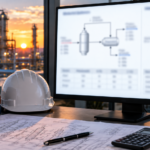
Process simulation allows engineers to create a mathematical representation of an industrial process.
Using information about materials, operating conditions and equipment behaviour, simulation tools can estimate how a process may respond under different conditions.
They have become an important part of modern process engineering, but they do not eliminate the need for engineering judgement.
A process model may include streams, process equipment and thermodynamic relationships.
Engineers enter information such as composition, flow, pressure and temperature, and the simulation calculates conditions throughout the model.
Depending on the application, the model may represent an entire process unit or only a specific part of the plant.
One of the major advantages of simulation is the ability to evaluate scenarios before modifying operating assets.
Engineers can explore questions such as:
What happens if feed composition changes?
What if production increases?
How could a different operating pressure affect separation?
Could a process modification reduce energy demand?
Simulation allows several alternatives to be screened without physically experimenting on the plant.
Simulation can also help identify how process constraints interact.
Increasing flow through one part of a plant may change pressure, heat duty or separation performance elsewhere.
A model can help engineers understand these relationships and identify where additional limitations might appear.
This makes simulation useful when assessing capacity-increase and debottlenecking projects.
Simulation results should not automatically be treated as reality.
Every model depends on assumptions.
Thermodynamic methods must suit the process. Equipment models need appropriate inputs. Plant data may contain measurement errors. Fouling, equipment deterioration and unusual operating behaviour may not be fully represented.
A model can produce a precise-looking answer even when its assumptions are poor.
For existing facilities, engineers often compare simulation results with actual operating data.
If the model cannot reasonably reproduce current plant performance, confidence in predictions of future conditions should be limited.
This process of checking and adjusting the model helps ensure it reflects actual plant behaviour closely enough for its intended purpose.
Process simulation is a decision-support tool.
It can help engineers explore scenarios, understand relationships and perform calculations efficiently.
But deciding whether a proposed change is practical also requires knowledge of equipment limitations, control behaviour, plant operability, safety and the realities of implementation.
Good process engineering uses simulation to strengthen judgement—not replace it.