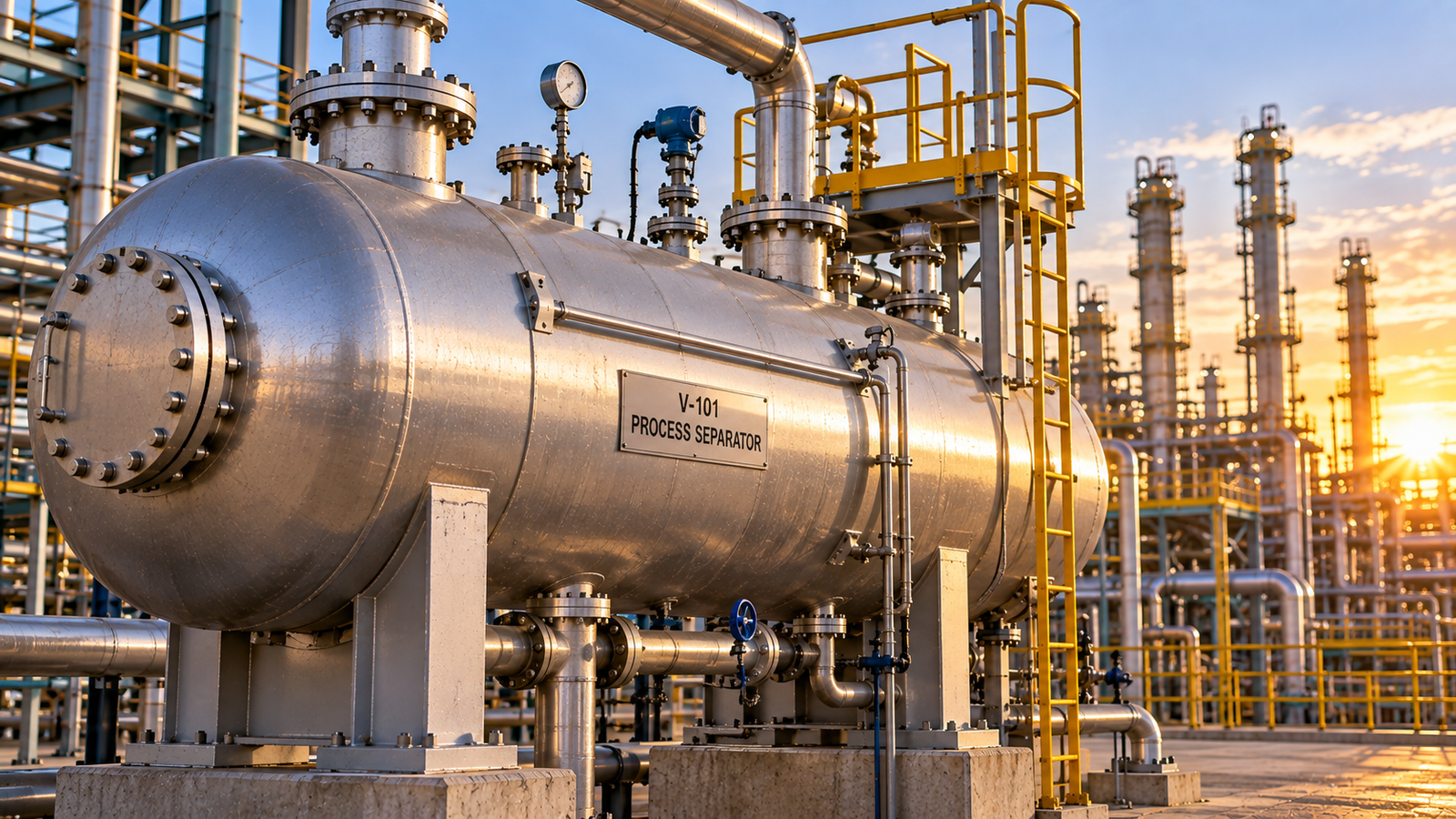
Pressure vessels are found throughout industrial plants as separators, drums, receivers and other process equipment.
At first glance, their function may appear simple: contain a fluid under specified conditions.
In reality, vessel design brings together pressure, temperature, materials, process requirements, internal components and access for inspection and operation.
A vessel needs to withstand the pressures and temperatures it may credibly experience.
These design conditions are not necessarily identical to normal operating conditions.
Engineers need to consider appropriate margins and the range of conditions that can occur during operation, start-up, shutdown and other relevant situations.
The contained fluid can influence material choice significantly.
Corrosion, temperature and compatibility with the process fluid all need consideration.
In some services, corrosion allowance may form part of the design philosophy.
In others, different materials, linings or protective approaches may be appropriate.
Many pressure vessels contain more than empty space.
Depending on their function, they may include:
These internals help the vessel perform its process duty.
Their design also needs to consider inspection, maintenance and possible removal.
Every vessel interacts with the surrounding process through its nozzles.
Process lines, vents, drains, instruments and safety-related connections all need appropriate locations.
Nozzle arrangement therefore requires coordination between equipment, piping, instrumentation and plant layout.
A technically correct nozzle that creates poor accessibility can still cause practical problems.
Vessels may require internal inspection during their operating life.
Manways and other access provisions need to support realistic inspection and maintenance activities.
External accessibility to instruments, valves and connections also matters.
These requirements are easier to address during design than after installation.
Pressure rating is essential—but it is only one part of vessel engineering.
A successful vessel needs to combine:
containment, process performance, suitable materials, practical connections and long-term accessibility.
That is why pressure vessels should be viewed as engineered process equipment rather than simply large steel containers.