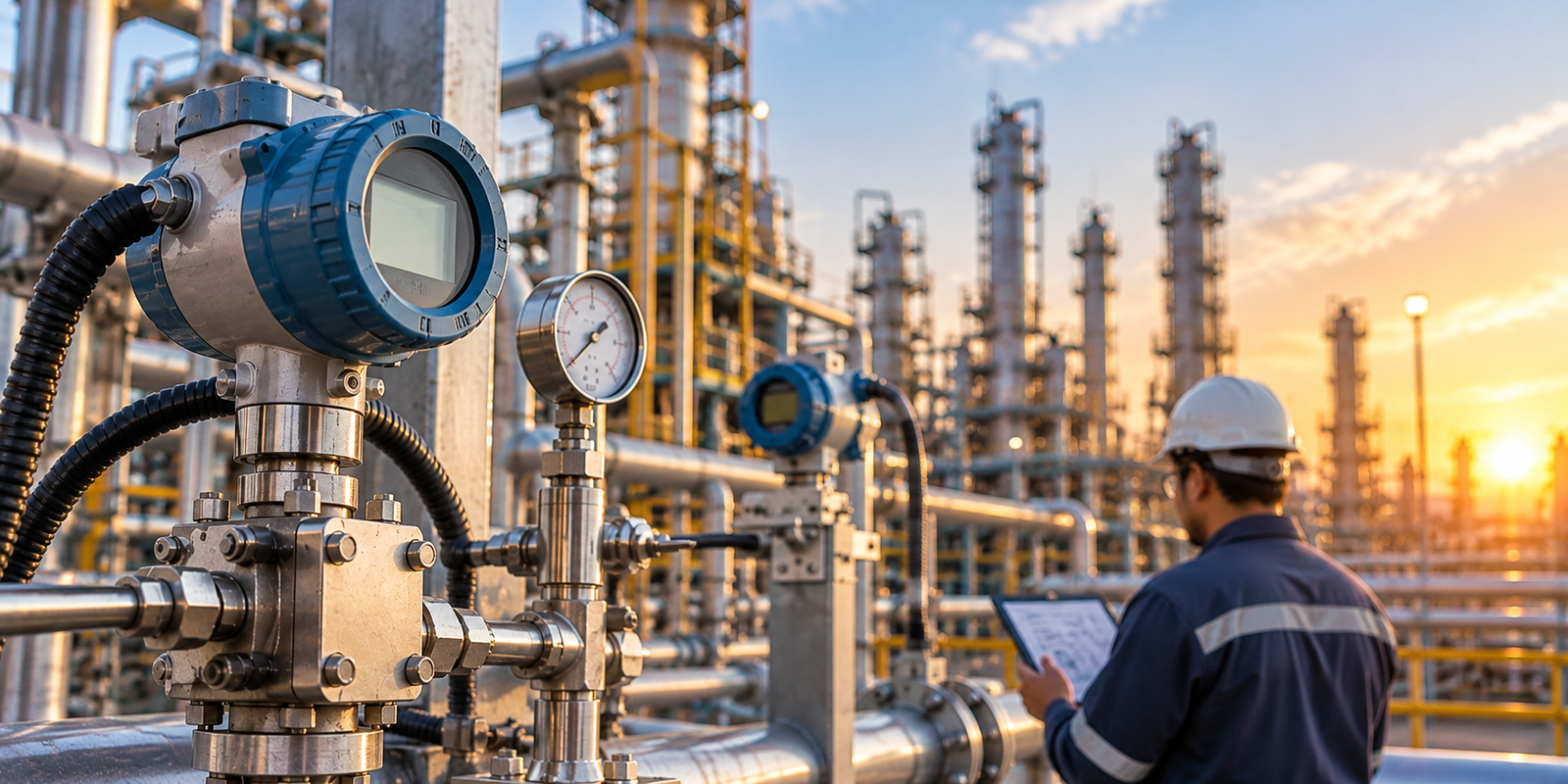
Industrial plants depend on measurements.
Pressure, temperature, flow and level are among the most common process variables monitored across refineries, chemical plants, power stations, steel plants and manufacturing facilities.
These measurements help operators understand what is happening inside equipment and piping that they cannot directly see.
But good instrumentation begins long before a transmitter is installed.
It begins with understanding what needs to be measured, why it matters and under what conditions the measurement must work.
A measurement should answer a real operating or engineering need.
It may be used to:
The required measurement quality depends partly on how the information will be used.
A measurement used only for general indication may not have the same requirements as one used for custody transfer, process control or a protective function.
Selecting an instrument without understanding the process can lead to problems even when the instrument itself is technically capable.
Engineers need to understand factors such as:
The actual application matters more than the instrument specification in isolation.
Instrumentation discussions often focus heavily on accuracy.
Accuracy is important, but it is not the only factor.
Repeatability, stability, response time, rangeability and reliability can all matter depending on the application.
A highly accurate instrument that frequently becomes blocked, drifts or fails under process conditions may deliver less useful information than a more robust solution suited to the service.
An instrument can be correctly selected and still perform poorly because of installation.
Pressure instruments may be affected by impulse-line configuration.
Flowmeters can be influenced by piping arrangement or disturbed flow.
Temperature measurements depend partly on the location and installation of the sensing element.
Level instruments can be affected by vessel internals, turbulence, foam or changing fluid properties.
Good measurement therefore depends on both instrument selection and installation engineering.
Instrumentation has to operate throughout the life of the plant.
Engineers should consider whether the device can be inspected, calibrated, isolated or replaced safely.
An instrument installed in an inaccessible location may create unnecessary maintenance difficulty.
Similarly, the environment around the device can affect long-term reliability.
Heat, vibration, moisture, dust and corrosion can all influence instrument performance.
Control systems can only make decisions using the information they receive.
If the measurement is unreliable, inaccurate or inappropriate for the application, even a sophisticated control strategy may perform poorly.
This is why measurement is often the foundation of effective process control.
Before asking what control system or software should be used, engineers need confidence in the field information feeding that system.
Good instrumentation starts with a simple question: