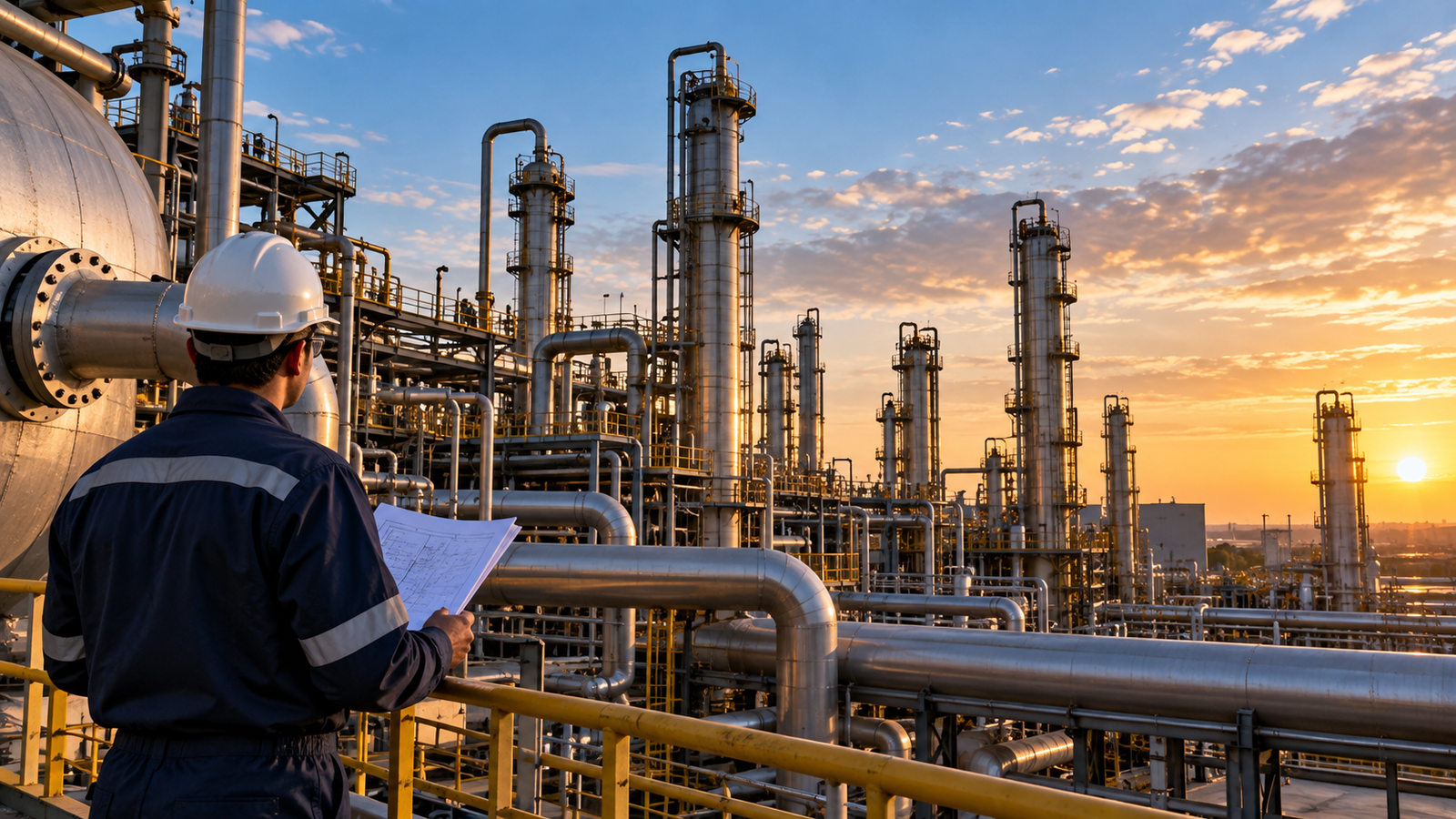
Industrial plants are often asked to produce more from assets that were designed years earlier. Building a new production line or expanding an entire facility may not always be practical, so engineers first look at whether additional capacity can be achieved from the existing process.
This is where process debottlenecking comes in.
Debottlenecking is the systematic identification and removal of constraints that prevent a process from achieving higher or more stable throughput. The constraint may be a piece of equipment, but it can just as easily be a utility limitation, hydraulic restriction, control issue or interaction between different parts of the process.
A bottleneck is not necessarily the largest or most obvious piece of equipment.
A heat exchanger that cannot provide sufficient duty, a compressor approaching its operating limit, excessive pressure drop in a piping system or insufficient cooling-water availability can all restrict overall plant capacity.
The key is to look at the process as an integrated system.
Increasing the capacity of one unit without understanding what happens downstream may simply move the bottleneck elsewhere.
Engineers typically begin by comparing actual plant performance with the conditions for which the process and equipment were designed.
Questions may include:
Historical operating data can help distinguish a temporary operational issue from a genuine process constraint.
A process bottleneck may result from several small limitations rather than one major problem.
For example, increasing feed to a process unit may require additional heating, cooling, pumping and separation capacity at the same time.
A change that appears simple at one point in the process can therefore affect several connected systems.
This is why process engineers often use heat and material balances, hydraulic calculations, equipment performance data and process simulation when evaluating debottlenecking opportunities.
Once the constraint has been identified, engineers can consider different ways to address it.
Some improvements may involve changes in operating conditions or process configuration. Others may require equipment modification, additional parallel equipment or changes to control strategy.
The objective is not simply to maximise throughput.
Any modification must also consider product quality, process stability, utility demand, equipment limits and safety.
Increasing plant capacity can change flows, pressures, temperatures and inventories throughout the process.
Relief systems, control systems, downstream equipment and existing safeguards may therefore need to be reviewed before higher operating rates are introduced.
Debottlenecking should never be treated as simply pushing existing equipment harder.
Debottlenecking can be attractive when additional production is required but a major expansion cannot be justified.
The most valuable opportunities are often those that improve use of existing assets without introducing disproportionate complexity or risk.
Ultimately, successful debottlenecking requires engineers to understand not just individual equipment, but how the entire process behaves as production conditions change.