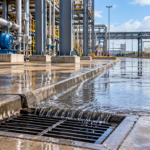

Storage tanks and chemical-handling areas are designed to keep liquids inside equipment and piping.
But industrial facilities also have to consider what happens if that primary containment fails.
Bund walls and other secondary-containment systems provide a controlled area in which leaked or spilled liquid can be retained rather than spreading across the plant.
Although the concept appears simple, effective containment depends on several civil and operational considerations.
A storage tank is the primary barrier between the stored liquid and the surrounding environment.
A bunded area provides a second layer of protection.
If a tank, connection or associated component releases liquid, the surrounding containment area is intended to prevent that liquid from spreading into neighbouring plant areas.
This can help reduce escalation, protect drainage systems and give operators more time to respond.
Secondary containment is therefore an important interface between civil engineering, environmental protection and plant safety.
A bund must have enough usable capacity for the scenario it is expected to contain.
The required volume depends on factors such as:
The nominal dimensions of the bund are not always the same as its effective containment capacity.
Equipment foundations, pipe supports and other structures occupying space inside the contained area reduce the volume available for liquid.
The floor inside a bunded area is normally arranged so that liquid does not simply remain scattered across a wide surface.
Suitable slopes can direct small spills or rainwater toward designated low points or collection systems.
This can make inspection, drainage and recovery easier.
However, drainage from containment areas needs to be controlled.
An open connection from a bund directly into the general plant drainage system could defeat the purpose of the containment if a tank release occurs.
Outdoor bunds inevitably collect rainwater.
If water is allowed to accumulate continuously, it reduces the available containment capacity.
Plants therefore need a controlled way of removing rainwater without allowing potentially contaminated liquid to escape.
This often requires inspection before drainage and operational procedures for opening and closing drain valves.
A simple civil structure therefore depends on disciplined operating practices to remain effective.
Pipes, cables and other services may need to pass through bund walls.
Every penetration creates a potential route through which liquid could escape.
The interface around these penetrations therefore needs appropriate sealing and detailing.
Cracking, damaged joints or deteriorated seals can reduce the effectiveness of the containment even when the wall itself remains structurally sound.
Regular inspection is important because many of these defects develop gradually.
Containment depends on both the wall and the floor.
Cracks or deterioration in the floor slab may allow spilled liquid to migrate into the ground.
The materials and protective systems used within the bund therefore need to be compatible with the liquids that could potentially be released.
In chemically aggressive services, ordinary concrete may require additional protection to resist degradation.
Tank farms and chemical-storage areas still need to be inspected and maintained.
Bund walls should therefore be designed with practical access in mind.
Stairs, crossings or other arrangements may be required so that operators and maintenance personnel can reach equipment without compromising containment.
The layout also needs to consider emergency access and evacuation.
A bund successfully containing a spill can still create a hazardous situation inside the contained area.
Depending on the liquid, there may be risks from vapours, fire, chemical exposure or accumulation around equipment.
Containment therefore works together with detection, emergency response, firefighting and drainage systems.
Its role is to limit the spread of the release while other protective measures are activated.
Bund walls and floors can deteriorate over time.
Plants should watch for issues such as:
Small defects can compromise containment performance if they remain uncorrected.
A bund may remain unused for years.
That does not make it unimportant.
Its value becomes apparent when primary containment fails and a plant needs to prevent a local leak from becoming a wider incident.
Effective secondary containment depends on adequate volume, sound civil construction, controlled drainage and continued inspection.
For industrial plants, the principle is straightforward: design the containment before the spill occurs, because once the release begins, there is little time to create it.