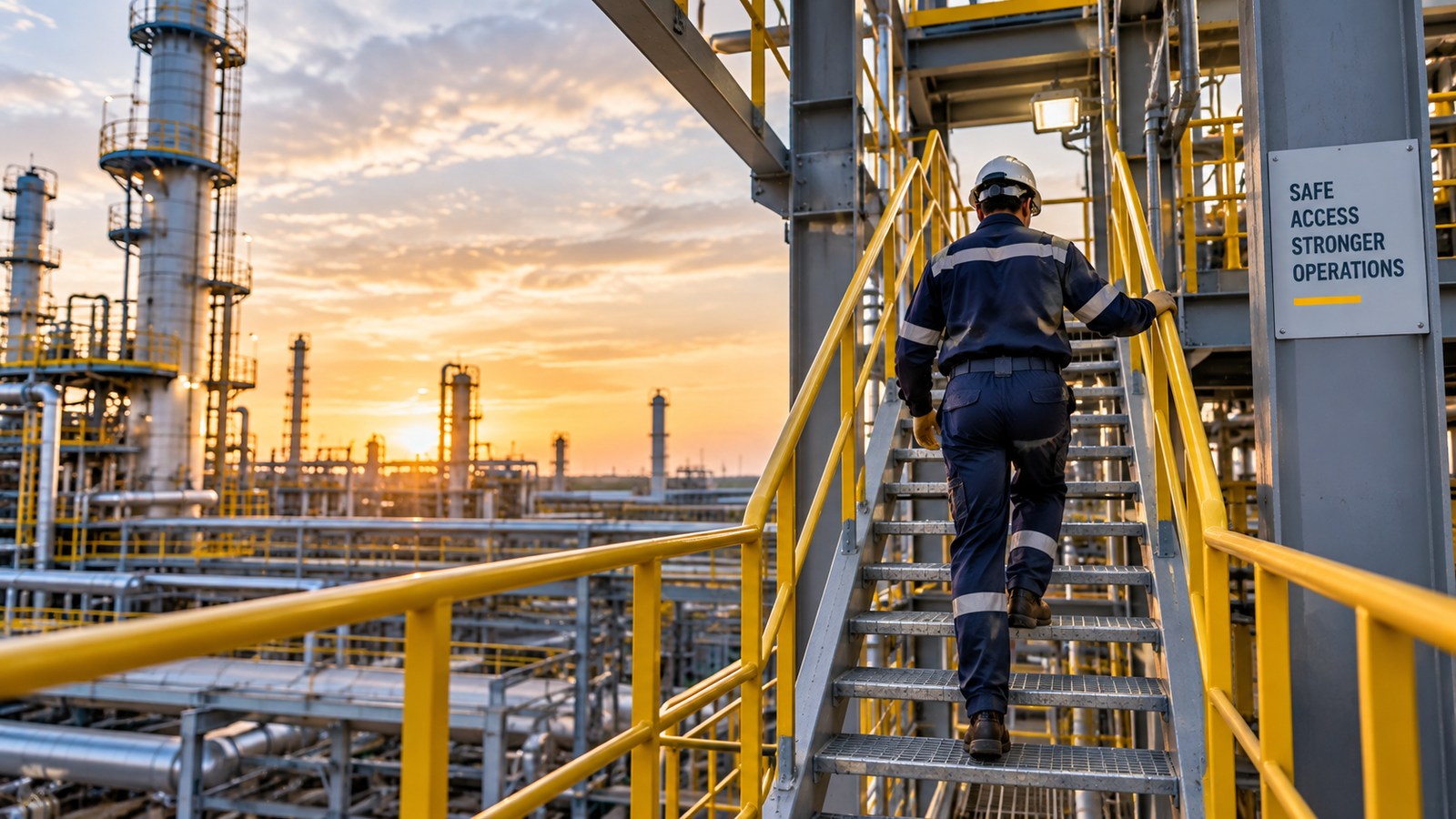
Industrial plants contain equipment that has to be operated, inspected and maintained at many different elevations.
Platforms, stairs, ladders and walkways make that access possible.
These structures may look secondary compared with process equipment, but poor access can create serious operational difficulties.
The first question is not simply where a platform can fit.
It is what people need to do there.
Typical activities may include:
The access arrangement should support the actual task.
A platform that is technically large enough to stand on may still be impractical for maintenance.
Personnel may need room for tools, removed components or lifting activities.
Clearance around equipment therefore matters as much as the platform itself.
Different access methods suit different situations.
Frequently accessed locations generally require more convenient routes than areas visited only occasionally.
Emergency escape requirements may also influence how platforms and stairways are arranged.
Platforms may support:
Their design therefore needs to consider realistic operating and maintenance conditions.
Industrial plants are crowded environments.
Piping, ducts, cables and structures can compete for the same space.
If access is considered too late, platforms may become awkward or obstructed.
Early coordination helps avoid this.
A plant may be mechanically sound, but poor access can make routine work slower and less safe.
Platforms and access structures therefore form an important part of plant engineering, not simply architectural convenience.